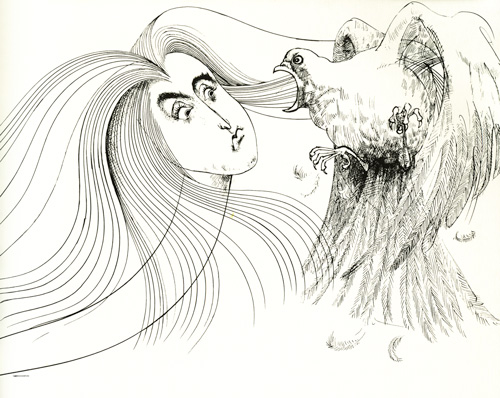
Anna Deavere Smith on the Art of Listening in a Culture of Speaking
“Some people use language as a mask. And some want to create designed language that appears to reveal them but does not.”
In his exquisite taxonomy of the nine kinds of silence, Paul Goodman included “the silence of listening to another speak, catching the drift and helping him be clear.” And yet so often we think of listening as merely an idle pause amid the monologue of makingourselves clear. Hardly anyone has done more to advance the art of listening in a culture of speaking more than artist, actor, playwright, educator, and enchantress of words Anna Deavere Smith, founder and director of Harvard’s Institute on the Arts and Civic Dialogue, and recipient of the prestigious MacArthur “genius” fellowship and the National Humanities Medal.
Half a century after John Cage demonstrated that we only hear what we listen for, Smith set out to explore her intuition that in order to develop a voice, one has to “develop an ear”; that words can be as much “the most important doorway into the soul of a person” as “the doorway into the soul of a culture.” She spent twenty-five years traveling and interviewing, at first, anyone who would talk to her — from the YMCA lifeguard to the lady at the clothing store register to a convicted murderer in a women’s prison — and, eventually, public figures like Christopher Hitchens and Studs Terkel, all the way up to then-President Bill Clinton. Smith would later use these interviews to “perform” the person in her acclaimed one-woman plays. The singular, immeasurably rewarding record of Smith’s journey lives on in Talk to Me: Listening Between the Lines (public library), subsequently released in paperback under the title Talk to Me: Travels in Media and Politics — an unusual meditation on public life via private identity, an investigation of truth-telling and lying, and an uncommonly insightful manifesto for the art of listening and the power of words in the architecture of character.
Smith writes:
The creation of language is the creation of a fiction. The minute we speak we are in that fiction. It’s a fiction designed, we hope, to reveal a truth. There is no “pure” language. The only “pure language” is the initial sounds of a baby. All of us lose that purity, and as we get more “of” the world, we even lose sometimes the capacity to keep that breath moving in our language.
In a sentiment that calls to mind Adrienne Rich’s crystalline conception of the liar as someone who loses sight of “the possibilities that exist between two people, or among a group of people,” Smith adds:
Our ability to create reality, by creating fictions with language, should not be abused. The abuse is called lying. Perhaps we understand the precariousness of our situation. We as linguistic animals. At the very least language is currency as we create “reality.” To abuse language, to lie, is to fray reality, to tatter it. Those in public life who create our values are especially asked not to “lie.” Yet most of us say, at least, that we believe we are often being lied to.
As Smith undertook this experiment in “what happens when you dare to move out of the margins and into another place,” a pivotal point in her journey of listening came when she met a linguist at a random party. She recounts trying to articulate to her the intuitive seed for the project — this effort to listen between the lines in the hope of hearing the realness people conceal beneath the comfort of familiar words:
We can learn a lot about a person in the very moment that language fails them. In the very moment that they have to be more creative than they would have imagined in order to communicate. It’s the very moment that they have to dig deeper than the surface to find words, and at the same time, it’s a moment when they want to communicate very badly. They’re digging deep and projecting out at the same time.
[…]
The idea is that the psychology of people is going to live right inside those moments when their grammar falls apart and, like being in a shipwreck, they are on their own to make it all work out.
Smith was looking for a way to get at precisely that unrehearsed language, so the linguist suggested three questions to crack the shell of verbal habit: “Have you ever come close to death?”; “Do you know the circumstances of your birth?”; and“Have you ever been accused of something that you did not do?” Armed with a simple Panasonic tape recorder and dogged dedication to what was at first merely an intuitive insight, Smith made these questions the springboard for her interviews. She eventually stopped asking them, but the questions, she notes, taught her how to listen. She recalls:
After I asked the questions, I would listen like I had never listened before for people to begin to sing to me. That singing was the moment when they were really talking.
In the early 1980s, she began taking that recorder — which eventually evolved as the technology did — all over America, culminating with Washington, D.C., and the President’s office, where she listened “for the talk, the talk of the big talkers, to turn, if only for a moment, into a song that they and only they can sing.”
Reflecting on the countless messages with which contemporary culture bombards us, from political propaganda to mundanities like airline safety instructions, Smith asks:
Who’s listening anymore? What does it take to get people to listen? When do people feel they need to listen? When do they feel they have to listen? … We get so used to hearing things that they have no meaning… We live with the expectation that words mean very little, because we have seen it all before, heard it all before. And that is why I find myself going on a quest down memory lane for a time when words meant something in my family, in my church, in my city, in my world.
She turns a particularly scrupulous eye to the professional purveyors of such meaningless din:
The press gather the information. But they do a lot more than gather and disseminate information. At their best moments, they use their wit to make us question power in a way that we may not have. And they must get our attention in the first place. They have to creep into the brains of the readers, or listeners, and alter the flow of our ideas.
[…]
It’s like a constant drip that affects the way we think, and the way we see the world. They can change us without our full awareness. It happens slowly, bit by bit, that we take on attitudes that are perpetuated in the media. How can we as a public regain control of words?
Illustration for ‘Alice in Wonderland’ by Leonard Weisgard.
The effort to reclaim the realness of words — of culture, of public life, of private truth — through acting may seem, at first, like a counterintuitive, even paradoxical approach. But Smith writes:
Acting is the furthest thing from lying that I have encountered. It is the furthest thing from make-believe. It is the furthest thing from pretending. It is the most unfake thing there is. Acting is a search for the authentic. It is a search for the authentic by using the fictional as a frame, a house in which the authentic can live. For a moment. Because, yes indeed, real life inhibits the authentic.
Citing the great director Joseph Chaikin’s formulation of presence as “the gift of the actor,” a “kind of deep libidinal surrender which the performer reserves for his anonymous audience,” she adds:
Presence is that quality that makes you feel as though you’re standing right next to the actor, no matter where you’re sitting in the theater. It’s the feeling you have that the performer is right in front of you, speaking to you and only you. It’s that wonderful moment when Jessye Norman sings in a quiet, so quiet you can hear a pin drop concert hall to an audience that is attentive like no other. It’s a moment when she seems to be singing as she’s never sung, and the audience seem to be listening as they’ve never listened. It’s the moment when it’s clear that everyone is there for the same reason… These moments have a kind of authenticity, because they reach the heart. They speak to us. They speak to us not because they are natural in the sense of normal. They speak to us because they are real in their effort to be together with a very large you, the you being all men and women.
Politicians and media manipulators, Smith argues, often try to borrow these skills, but the result is mere simulacra speaking to very few. More than a decade before the golden age of social media, Smith offers a perspective of extraordinary prescience and urgent timeliness today:
That genuine moment, that “real” connection, is no small thing. It is not something that happens every day. Is it rare because it calls for a special talent? Is it a moment that can happen only when we don’t know each other, when we have so much to learn about each other that we hang on every breath together? It is hard to find those moments in our culture because we think we know so much about each other. Perhaps it is a moment that is dependent not only on the performer or the leader, but on the audience as well. Does this era of focus groups and polls, this desire to get at and quantify the mysteriousness of that “deep libidinal surrender,” make it nearly impossible to find those moments of true engagement? Does the overdetermined nature of our time, and the inherent desire to control the public, to control their thoughts, particularly how they work those thoughts into actions that are favorable to the marketplace, create an atmosphere where only the predictable can occur? Those moments of deep libidinal surrender are in fact all about that which is not predictable. And there is no anonymous audience. At least that’s what the pollsters would like, what commerce would like. They would like to make the anonymous audience fully identifiable. With no anonymous audience, there can be no deep libidinal surrender.
[…]
We’re having a hard time connecting in public.
Photograph by Molly Malone Cook from ‘Our World’ by Mary Oliver.
At once a lament and a call to action, Smith’s observation rings even truer today:
We are in a communications revolution. Yet, as the great Americanist Studs Terkel tells us, “We’re more and more into communications and less and less into communication.” In this time of a global economy and business mergers happening as often as sunrise and sunset, where is the human merger? Where is real human engagement?
It’s interesting to note, here, that in the decade since Smith’s contemplation, the word “engagement” itself has been co-opted by the mass media as precisely the kind of marketable metric that dehumanizes how we connect in public. In the language of online media, “engagement” measures meaningless statistics about “user” behavior — and what better way to indicate that one is not listened to than being called a “user”? — that become simulacra for the genuine moments, those moments of “deep libidinal surrender,” which Smith so aptly identifies as the true measure of connection. “Engagement,” under the tyranny of this vocabulary, is interested in the very smallest you, not Smith’s large you of our shared humanity.
If there is any hope for us, it lies in relearning to tell the truth and hear it, in reclaiming ourselves as a listening species.
Illustration by Maurice Sendak from ‘Open House for Butterflies’ by Ruth Krauss.
Smith traces her love of words and her fascination with their power to her grandfather — a “tall, thin, and aristocratic looking” patriarch called Pop who, despite only having an eight-grade education himself, managed to send all six of his kids to college. “He and I were good friends, because he liked to talk, and I liked to listen,” Smith recalls. “He is the one who taught me the kernel of all that I understand about acting.” That kernel was contained in a single sentence her grandfather liked to repeat, which eventually became the lens for Smith’s art:
I take the words I can get and try to occupy them. Using the idea that my grandfather gave me — “If you say a word often enough it becomes you” — I borrow people for a moment, by borrowing their words. I borrow them for a moment to understand something about them, and to understand something about us. By “us,” I mean humans.
In these borrowed words, and in the act of borrowing itself — which is predicated on the act of listening — Smith found a rare gateway into the depths of the human experience:
Placing myself in other people’s words, as in placing myself in other people’s shoes, has given me the opportunity to get below the surface — to get “real.”
[…]
Some people use language as a mask. And some want to create designed language that appears to reveal them but does not. Yet from time to time we are betrayed by language, if not in the words themselves, in the rhythm with which we deliver our words. Over time, I would learn to listen for those wonderful moments when people spoke a kind of personal music, which left a rhythmic architecture of who they were. I would be much more interested in those rhythmic architectures than in the information they might or might not reveal.
[…]
I wanted to get people to talk to me, in a true way. Not true in the sense of spilling their guts. Not true in the sense of the difference between truth and lies. I wanted to hear — well — authentic speech, speech that you could dance to, speech that had the possibility of breaking through the walls of the listener, speech that could get to your heart, and beyond that to someplace else in your consciousness.
She contemplates what makes speaking from an authentic place so challenging for most of us and why we protect that place by shrouding it in all kinds of pre-learned patterns of packaged speech:
Speaking calls for risk, speaking calls for a sense of what one has to lose. Not just what one has to gain.
Talk to Me is a dimensional and immensely insightful read in its totality, perhaps even timelier today than when it was first released in 2001. Complement it with Smith on what self-esteem really means and how to stop letting others define us, then revisit John Francis on what the ragged edge of silence taught him about listening.




You must be logged in to post a comment.