Desire

Desire is like constructivism in architecture:

We never desire something or someone out of a context, we never desire it as an isolated entity even if we want to believe that we really do.
We always desire in a set of data, in a landscape. That’s why Proust said: “I do not desire the woman but the landscape wrapped in that woman”. Obviously we can only sense it and its interpretation depends on our own redundancy and our own tree structure.

Find out the relationship between the different elements that constitute the whole imagery is the key to understand the construction of desire. That’s why I’ve always said that the heart does not have any arithmetic but only geography.

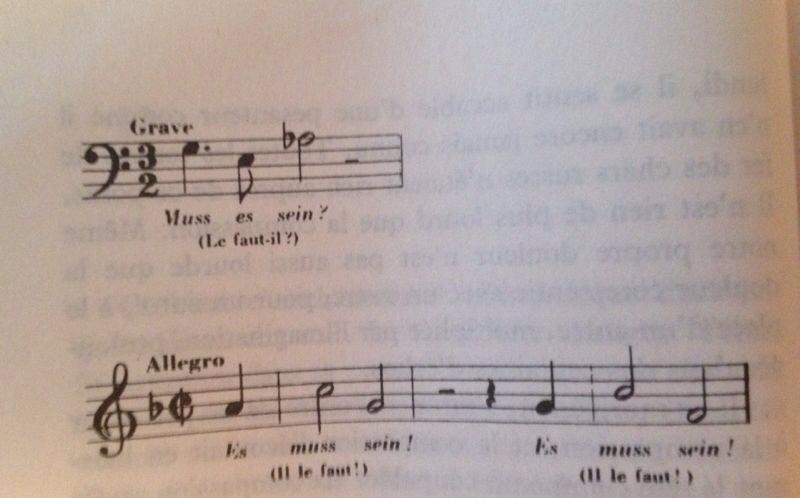
Beethoven’s “Muss es sein?”

Tags

,

1512361_10152655051091011_7467025476769022016_n

Beethoven’s last completed work before his death was the Opus 135 String Quartet whose last movement is entitled: “Der schwer gefasste Entschluss” meaning “The Resolution hard to take” or “The Difficult Decision.” Three ominous notes open the movement and were marked: “Muss es sein?” (“Must it be?”…A very definite fear and anxiety is expressed by this motif which is then replaced by an upbeat reply designated: “Es muss sein! Es muss sein!” (“It must be! It must be!”)… Many believe that what Beethoven was trying to convey was the feeling of being before the Great Eternal, the Awesome specter of God … We are uncertain and cowered by it, but when we see the Truth we embrace and rush towards it…. Personally I think that Everything that occurs out of necessity, everything expected, repeated day in and day out, is mute. Only chance can speak to us…This is an important line. What happens by fate = what happens by necessity = what is repeated = that which belongs to the realm of eternal return. What happens by chance = the fortuitous = what happens only once. And what happens only once, by chance, can have meaning, too…

It’s a complicate lightness/weight dichotomy….because it argues that what happens only once can have meaning…

The thickness of things

Apache tears

Must bee seen

The crawling blade

That we believed to be the sea

Those bodies that were believed to feel

Untie their incredible prehistories

Like the water on dumb temple pilots

Inner excavation opens a garden of stones

They consent to silence

To the immobility of the leaves before the storm

For a wing to unfold in the light of aging

The bird in a metal flight

Comes like the rain through the observable

I am free cried the bird from love gripped

Just take what is alive

I will burn the stone

The wind mistaken wheat

Silence doesn’t disunite

His flesh in words of core aims and bends

Our intimate orchards

The line takes off

Cutting edges

Of the white hole in the gesture

No door for departure

Use only the faithful and naked Coal

I remember a lovely July

The pure echo of demolished walls

A foot, a wing in Buci

I remember my voice lost in other vocals

And Guillevic

I remember the thickness of things

The hand that holds

The blue abyss

Inks

We will go for tomorrow

Full of doubts and wheat

I wait as only shadow could

Surrounded by the sun

Look for a meaning to eclipses

Forget my decipherable shadow

Let only my stone bear down

No voice left to bend the other voices

My real world is silent

In the unexplored retread of me

Rises a metamorphic seed

The stone

And it birds weigh

There is a story that is told

Then the waves, the stunning waves

I have for her the obvious

Dead shoes

Unknown caramels

And perfumes from Edo

the thickness (2)

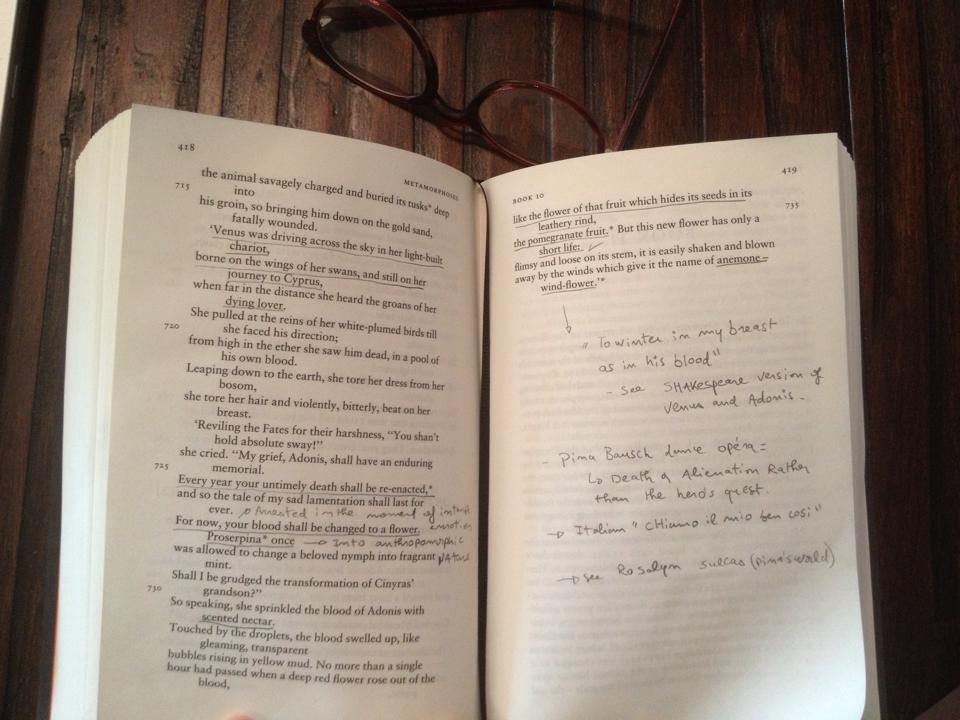
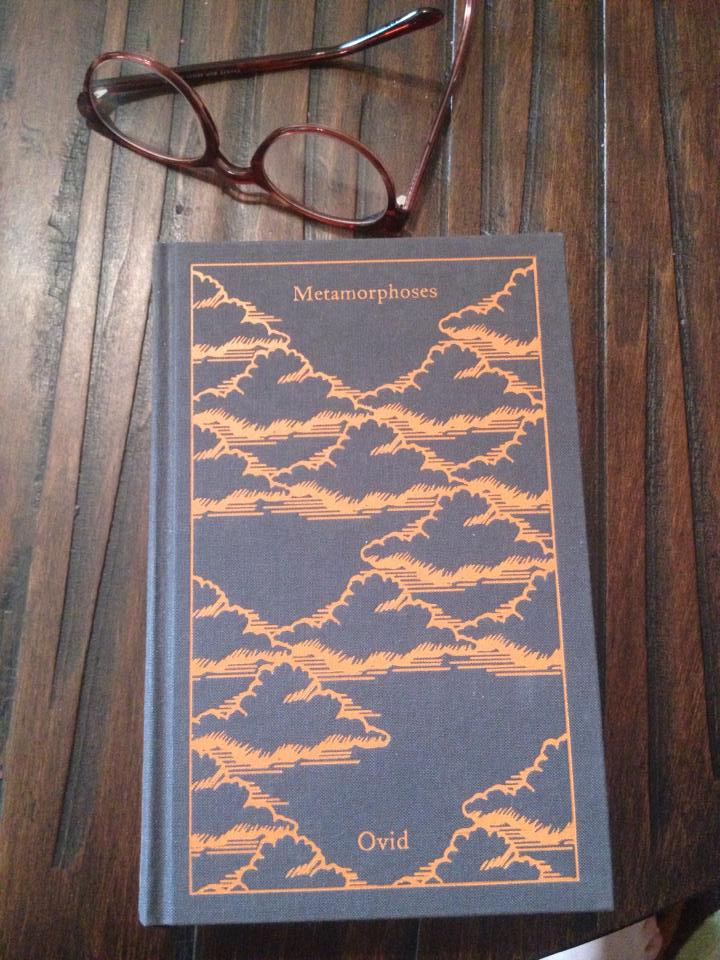
Ovid Metamorphosis and anthropomorphic nature

10612743_10203416509040547_8473834274752616920_n (1)10943773_10203416508760540_7650902208815166083_n

Ovid is ultimately more interested in the beginnings than the ends…The poems cannot be described as tragedies, this is partly because as in Ovid, Metamorphosis lets the characters off the hook, they are arrested in the moment of intense emotion and released into a visual, vibrant, colourful world of anthropomorphic nature.

DIRES 5

Spinoza dirait: “Oui, nous pouvons porter secours à la tristesse, dehors, de l’autre côté, râteau à la main” … Parce que ce ne est pas évident que quelque chose émerge de la substance massive, dehors il y a l’énormité d’un instant d’expérience pure = ensemencement. C’est pourquoi j’aime la sculpture de Giacometti: En raison de son pouvoir plastique, je veux dire la puissance qui permet à quelqu’un de développer un procédé original et indépendant, à assimiler le passé, à guérir les blessures, réparer les pertes, et reconstruire sur son propre fond les formes brisées.

WORDS 5

Spinoza said: “Yes we can HELP the sadness, out there, in the other side, rake in the hand”…Because it’s not obvious that something emerges from the massive substance, outside there is the huge moment of pure experience = seeding. That’s why I love giacometti’s sculpture: Because of its plastic power, I mean the power that allows someone to develop an original and independent process to assimilate the past, heal the wounds, repair the losses, and reconstruct on his own background the broken shapes.