On the blue summer evenings, I shall go down the paths,
Getting pricked by the corn, crushing the short grass:
In a dream I shall feel its coolness on my feet.
I shall let the wind bathe my bare head.
I shall not speak, I shall think about nothing:
But endless love will mount in my soul;
And I shall travel far, very far, like a gipsy,
Through the countryside – as happy as if I were with a woman.
Arthur Rimbaud
Par les soirs bleus d’été, j’irai dans les sentiers,
Picoté par les blés, fouler l’herbe menue :
Rêveur, j’en sentirai la fraîcheur à mes pieds.
Je laisserai le vent baigner ma tête nue.
Je ne parlerai pas, je ne penserai rien,
Mais l’amour infini me montera dans l’âme ;
Et j’irai loin, bien loin, comme un bohémien,
Par la Nature, heureux- comme avec une femme.
“Our leaders strain every nerve and with success, to get the next war going, while the rest of us, meanwhile, dance the fox trot, earn money and eat chocolates…And perhaps…it has always been the same and always will be, and what is called history at school, and all we learn by heart there about heroes and geniuses and great deeds and fine emotions, is all nothing but a swindle invented by the schoolmasters for educational reasons to keep children occupied for a given number of years. It has always been so and always will be. Time and the world, money and power belong to the small people and shallow people. To the rest, to the real men belongs nothing…eternity…it isn’t fame. Fame exists in that sense only for the schoolmasters. No, it isn’t fame. It is what I call eternity…The music of Mozart belongs there and the poetry of your great poets. The saints, too, belong there, who have worked wonders and suffered martyrdom and given a great example to men. But the image of every true act, the strength of every true feeling, belongs to eternity just as much, even though no one knows of it or sees it or records it or hands it down to posterity. In eternity there is no posterity…It is the kingdom on the other side of time and appearances. It is there we belong. There is our home. It is that which our heart strives for…And we have no one to guide us. Our only guide is our homesickness.”
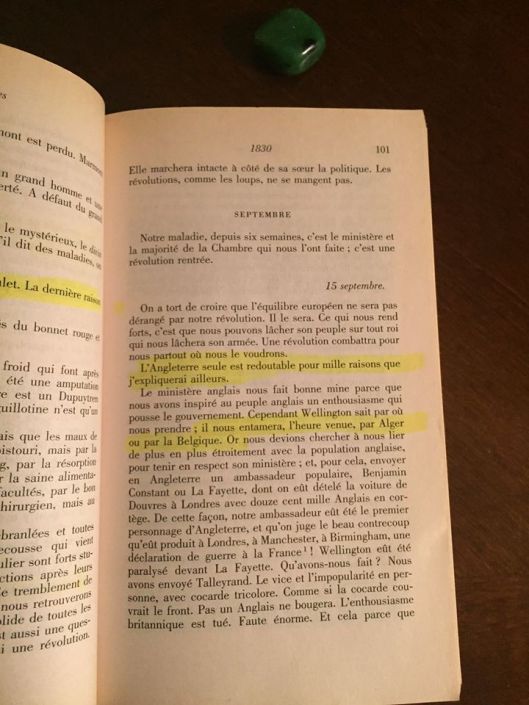
« J’ai toujours marché avec l’opinion de cinq à six millions d’hommes. Malgré tous les libelles, je ne crains rien à ma renommée : la postérité me rendra justice ; la vérité sera connue, et l’on comparera le bien que j’ai fait avec les fautes que j’ai commises ; je ne redoute pas le résultat de l’examen. Si j’eusse réussi, je serais mort avec la réputation du plus grand homme qui eût existé. Dans l’état où sont les choses, quoique j’ai échoué, je serai encore considéré comme un homme extraordinaire. Mon élévation est unique dans l’histoire, parce qu’elle n’est le résultat d’aucun crime. J’ai combattu dans cinquante batailles, que j’ai presque toutes gagnées ; j’ai tracé et fait mettre à exécution un code de lois qui portera mon nom à la postérité la plus reculée. De rien, je suis devenu par moi-même le monarque le plus puissant du Monde : j’ai vu l’Europe à mes pieds. Mon ambition était grande, je l’avoue ; mais elle était froide et causée par les événements […]. Appelé à la tête de la Nation, ma maxime fut : carrière ouverte aux talents sans distinction de naissance ou de fortune ; c’est pour ce système méritocratique que l’oligarchie anglaise me déteste tant. »
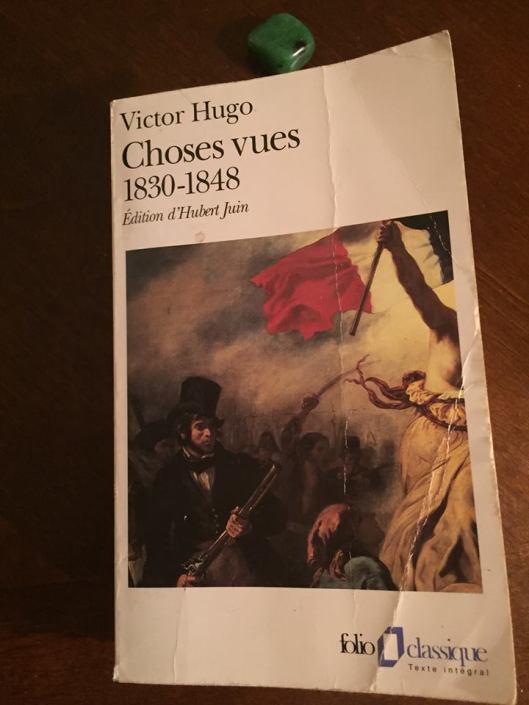
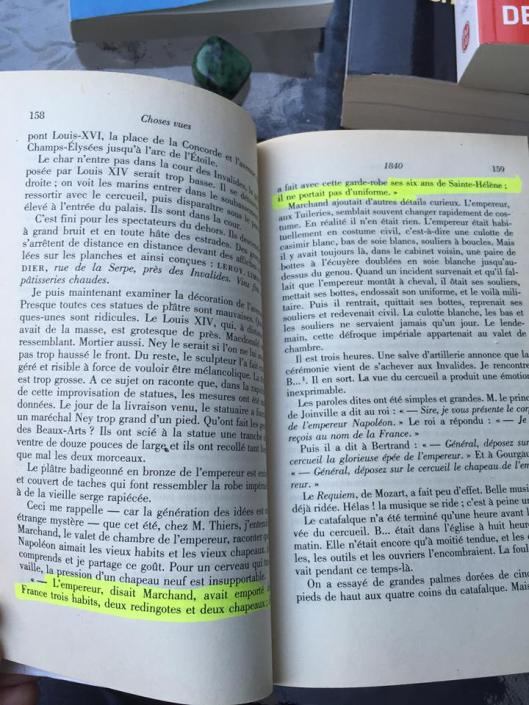
La dernière fois que j’ai vu mon père il m’a donné ce livre de Victor Hugo ”Choses vues” avec cette étrange couverture de Delacroix ou on ne voit qu’un sein.
J’avais pensé alors que j’en avais assez de ses classiques, je ne saurais dire combien de fois je les aies lus et relus et que ça ne pouvait rien m’apporter de nouveau.
Ce soir je me suis enfin décidé à y jeter un coup d’œil avec circonspection et la prudence d’un type en cavale…J’y retrouve cette merveilleuse manie qu’a mon père et qui nous a toujours rapproché au plus haut point intellectuel, de raturer des mots, des phrases, d’y bombarder de grosses goutes d’encre.
Une certaine émotion s’empare de moi lorsque je les reprends. De me poser la question du pourquoi telle ou telle phrase avait été soulignée. C’est ainsi que nous avons toujours dialogué dans la distance et la proximité.
Les livres les plus forts, on a beau se dire qu’à force de les fréquenter on les connait par cœur, chaque nouvelle lecture se révèle une bouleversante et excitante première fois.
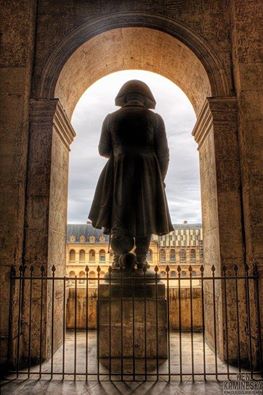
C’est ainsi que je me dis que je devrais voyager comme Napoléon (Page 158 plus haut) avec deux redingotes et deux chapeaux.
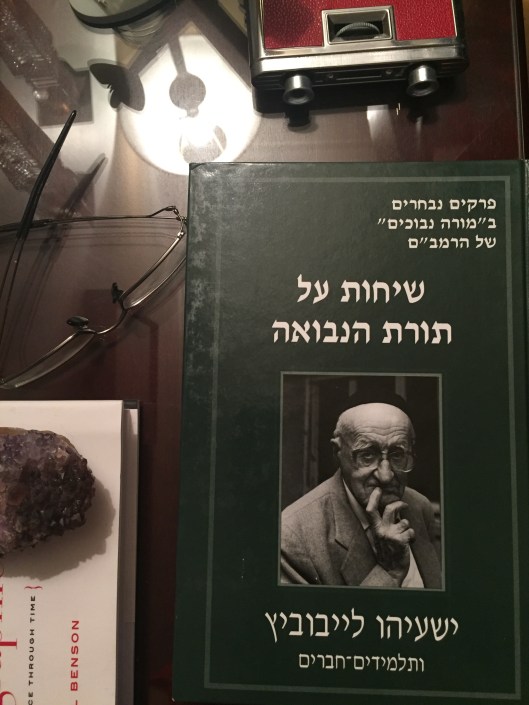
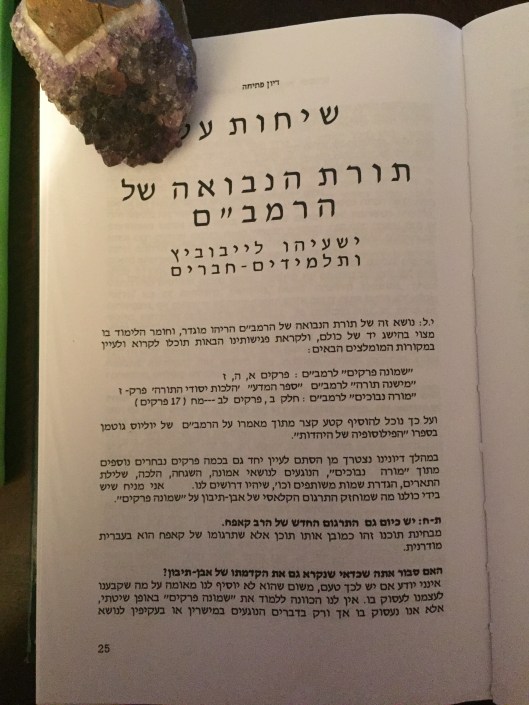
I just started to read ”שיחות על תורת הנבואה” of Yeshayahu Leibowitz and I am already fascinated. Even if I see many similarities between Leibowitz, Nietzsche and Hannah Arendt regarding the notions of truth and reality ( Hannah Arendt cautioned that “the basic fallacy … is to interpret meaning on the model of truth.” ) I find in Leibowitz work a honest tentative to bridge the gap between meaning, which is the human interpretation of truth, and that naked truth itself and it’s perhaps the most abiding challenge in reconciling the human intellect with the human spirit.
Conclusions – I – about the concept of truth:
On page 1-25 :
Telling the truth will not help, unless the listener has the tools for understanding the truth. You can not tell the truth – the truth needs to be revealed.
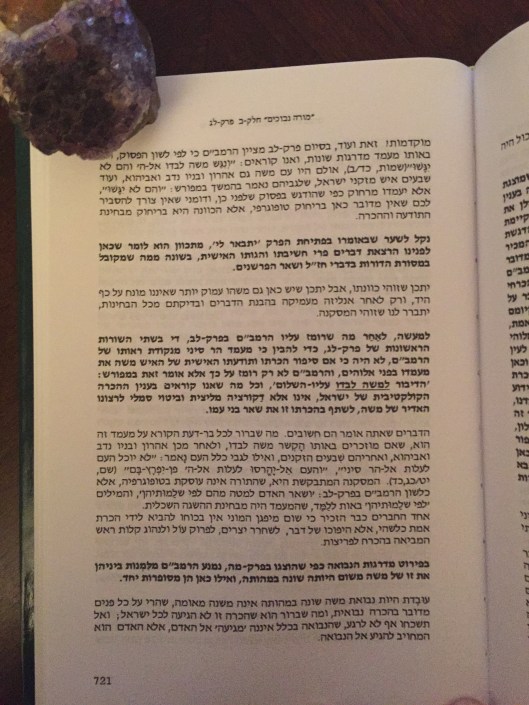
On page 721 :
Mass rally ( at Mount Sinai) can not lead to knowledge of the truth, but rather the opposite – a mass rally leads to the liberation of passion, bolt, and frivolity.
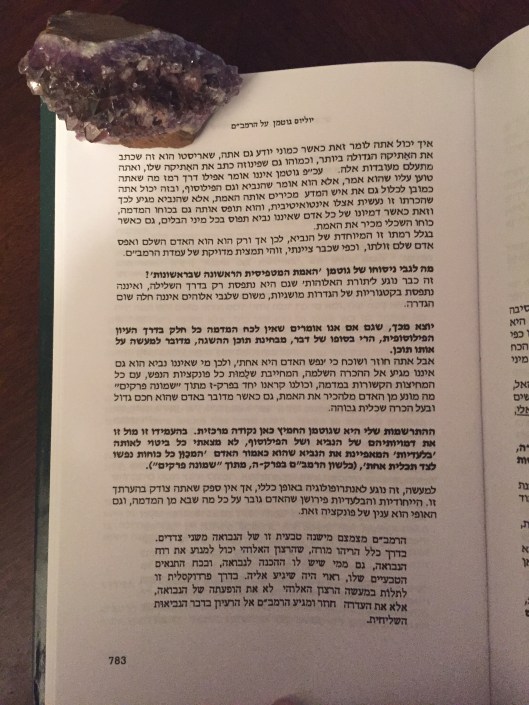
On Page 783 :
He who is not a prophet, his imagination is busy with trivialities, even if mentally it’s the truth.
”Here I am developing an idea that Walter Benjamin addressed in his Arcades Project. He starts from the anthropological assumption that people in all epochs dedicate themselves to creating interiors, and at the same time he seeks to emancipate this motif from its apparent timelessness. He therefore asks the question: How does capitalist man in the 19th century express his need for an interior? The answer is: He uses the most cutting-edge technology in order to orchestrate the most archaic of all needs, the need to immunize exist-ence by constructing protective islands. In the case of the arcade, modern man opts for glass, wrought iron, and assembly of prefabricated parts in order to build the largest possible interior. For this reason, Joseph Paxton’s Crystal Palace, erected in London in 1851, is the paradigmatic building. It forms the first hyper-interior that offers a perfect expression of the spatial idea of psychedelic capitalism. It is the prototype of all later theme-park interiors and event architectures. The arcade heralds the abolition of the outside world. It abolishes outdoor markets and brings them indoors, into a closed sphere. The antagonistic spatial types of salon and market meld here to form a hybrid. This is what Benjamin found so theoretically exciting: The 19th-century citizen seeks to expand his living room into a cosmos and at the same time to impress the dogmatic form of a room on the universe. This sparks a trend that is perfected in 20th-century apartment design as well as in shopping-mall and sports-stadium design—these are the three paradigms of modern construction, that is, the construction of micro-interiors and macro-interiors.” Peter Sloterdijk
Instead of this archaic state of protection I prefer the words of Cioran:
”The absence of an organic character of the contemporary culture, makes that man is no longer living in contents but in formulas that he can change as fast as he changes his shirt. So you understand why it is necessaryto purify oneself on the heights.” The full text below ( In French only).
Kazakh hunters in Altai Mountains in Western Mongolia :
”Here I am developing an idea that Walter Benjamin addressed in his Arcades Project. He starts from the anthropological assumption that people in all epochs dedicate themselves to creating interiors, and at the same time he seeks to emancipate this motif from its apparent timelessness. He therefore asks the question: How does capitalist man in the 19th century express his need for an interior? The answer is: He uses the most cutting-edge technology in order to orchestrate the most archaic of all needs, the need to immunize exist-ence by constructing protective islands. In the case of the arcade, modern man opts for glass, wrought iron, and assembly of prefabricated parts in order to build the largest possible interior. For this reason, Joseph Paxton’s Crystal Palace, erected in London in 1851, is the paradigmatic building. It forms the first hyper-interior that offers a perfect expression of the spatial idea of psychedelic capitalism. It is the prototype of all later theme-park interiors and event architectures. The arcade heralds the abolition of the outside world. It abolishes outdoor markets and brings them indoors, into a closed sphere. The antagonistic spatial types of salon and market meld here to form a hybrid. This is what Benjamin found so theoretically exciting: The 19th-century citizen seeks to expand his living room into a cosmos and at the same time to impress the dogmatic form of a room on the universe. This sparks a trend that is perfected in 20th-century apartment design as well as in shopping-mall and sports-stadium design—these are the three paradigms of modern construction, that is, the construction of micro-interiors and macro-interiors.”
Peter Sloterdijk
Instead of this archaic state of protection I prefer the words of Cioran:
”The absence of an organic character of the contemporary culture, makes that man is no longer living in contents but in formulas that he can change as fast as he changes his shirt. So you understand why it is necessaryto purify oneself on the heights.” The full text below ( In French only).
”Si l’on veut comprendre la vanité des ambitions et des aspirations cultivées par l’homme dans les grandes villes, si l’on veut dépasser les illusions engendrées par l’assimilation au rythme fou de la vie moderne, il est plus que nécessaire, il est indispensable de faire provisoirement retraite. ”( …) ”L’absence de caractère organique de la culture contemporaine fait que l’homme ne vit plus dans des contenus mais dans des formules dont il peut changer comme il changerait de chemise. vous comprenez donc pourquoi il est nécessaire de se purifier sur les hauteurs. ” Emil Cioran
Kazakh hunters in Altai Mountains in Western Mongolia :
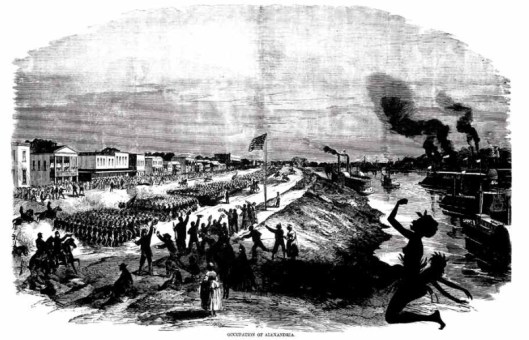
Kara Walker is one of the most complex artist of this generation. She can make work that so effectively get the complexity of Human nature and critically address race, gender, sexuality and power. She investigates the darker aspects of American culture and human psyche.
Her last exhibition is currently held at The MOMA, and it consist on annotation of the original edition of Harper’s Pictorial History of the Civil War, published in 1866 by Alfred H.Guernsey. The goal of that edition was to narrate events just as they occured and Kara Walker challenges the truth Guensey claimed to recount and unjects a discourse about rightness and wrongness the author professed to omit. Walker’s silhouetttes of distorted fragments and flailing balck bodies are silkscreened over enlargement and she incoporates new understading of suffering, loss and horror from the nineteenth century illustrations.
”These prints,” Walker explains, ” are the landscapes that I imagine exist in the back of my somewhat more austere wall pieces”
Her use of silhouettes may depit figures as racially stereotyped, and illustrate the emergence of racial anthropology in the late eighteenth century, particulary the concept of physiognomy.




You must be logged in to post a comment.