Trois jouissances:
Le Char céleste dans Daniel
La réforme de l’entendement chez Spinoza
Ou le mutisme forain et effroyable de Hoderlin.
DIRES 3
22 Thursday Jan 2015
22 Thursday Jan 2015
Trois jouissances:
Le Char céleste dans Daniel
La réforme de l’entendement chez Spinoza
Ou le mutisme forain et effroyable de Hoderlin.
22 Thursday Jan 2015
Posted in WORDS
BY accepting that a perfectly simple idea can not be false, what does it means simple if not form?
22 Thursday Jan 2015
Posted in DIRES
En acceptant qu’une idée parfaitement simple ne puisse pas être fausse, que veut dire simple sinon forme ?
22 Thursday Jan 2015
Posted in WORDS
I want like Walter Benjamin, that all my friends live where I live, especially the dead.
22 Thursday Jan 2015
Posted in DIRES
Je veux comme Walter Benjamin, que tous mes amis vivent ou je vis, spécialement les morts.
22 Thursday Jan 2015
Posted in translation
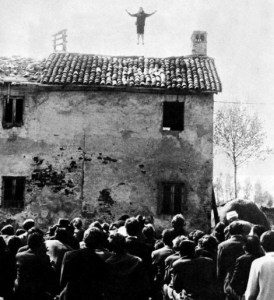
“Loneliness” by Pier Paolo Pasolini
You must be very strong
to love solitude; you have to have good legs
and a resistance out of the ordinary; you should not risk
colds, flu and sore throat; you should not fear
robbers or murderers; if you have to walk
throughout the afternoon or maybe all night
you must do it without realizing it; to sit there;
especially in winter; with the wind pulling the wet grass,
and with large stones from the rubbish damp and muddy;
there’s just no comfort, no doubt about it,
in addition to have in front of a whole day and a night
without duties or limitations of any kind.
Sex is a pretext. For how many meetings
– And even in winter, the streets abandoned to the wind,
between the expanses of garbage against distant buildings,
they are many – are but moments of solitude;
more warm and alive is the body kind
anointing of seed and leaves,
colder and is mortal beloved around the desert;
that it is filled with joy, like a miraculous wind,
not the innocent smile, or the murky bullying
who then leaves; He carries around a youth
enormously young; and this is inhuman,
because it leaves no trace, or rather, leaves only a trace
that is the same in all seasons.
A boy to his first loves
is nothing but the fertility of the world.
And ‘the world as it comes to him; appears and disappears,
as a form that changes. Remain intact all things,
and you can take half the city, no longer find it again;
the act is performed, its repetition is a ritual. therefore
loneliness is even greater if a whole crowd
waits his turn: a growth in the number of disappearances –
the leave is to escape – and the following looms over this
as a duty, a sacrifice to be made to feel like death.
As we age, however, the fatigue begins to be felt,
species in the moment in which it is just past the dinner hour,
and you did not change anything: then by a whisker not scream or weep;
and what would be huge if it were not precisely only fatigue,
and perhaps a bit ‘of hunger. Huge, because it would mean
your desire for solitude could not be more satisfied
and then what do you expect, if that is not considered solitude
is the true solitude, the one that you can not accept?
There is no dinner or lunch or satisfaction in the world,
it’s worth a walk endlessly for poor roads
where you have to be miserable and strong, brothers of the dogs.
Original in Italian :
“La solitudine” di Pier Paolo Pasolini
Bisogna essere molto forti
per amare la solitudine; bisogna avere buone gambe
e una resistenza fuori dal comune; non si deve rischiare
raffreddore, influenza e mal di gola; non si devono temere
rapinatori o assassini; se tocca camminare
per tutto il pomeriggio o magari per tutta la sera
bisogna saperlo fare senza accorgersene; da sedersi non c’è;
specie d’inverno; col vento che tira sull’erba bagnata,
e coi pietroni tra l’immondizia umidi e fangosi;
non c’è proprio nessun conforto, su ciò non c’è dubbio,
oltre a quello di avere davanti tutto un giorno e una notte
senza doveri o limiti di qualsiasi genere.
Il sesso è un pretesto. Per quanti siano gli incontri
– e anche d’inverno, per le strade abbandonate al vento,
tra le distese d’immondizia contro i palazzi lontani,
essi sono molti – non sono che momenti della solitudine;
più caldo e vivo è il corpo gentile
che unge di seme e se ne va,
più freddo e mortale è intorno il diletto deserto;
è esso che riempie di gioia, come un vento miracoloso,
non il sorriso innocente, o la torbida prepotenza
di chi poi se ne va; egli si porta dietro una giovinezza
enormemente giovane; e in questo è disumano,
perché non lascia tracce, o meglio, lascia solo una traccia
che è sempre la stessa in tutte le stagioni.
Un ragazzo ai suoi primi amori
altro non è che la fecondità del mondo.
E’ il mondo così arriva con lui; appare e scompare,
come una forma che muta. Restano intatte tutte le cose,
e tu potrai percorrere mezza città, non lo ritroverai più;
l’atto è compiuto, la sua ripetizione è un rito. Dunque
la solitudine è ancora più grande se una folla intera
attende il suo turno: cresce infatti il numero delle sparizioni –
l’andarsene è fuggire – e il seguente incombe sul presente
come un dovere, un sacrificio da compiere alla voglia di morte.
Invecchiando, però, la stanchezza comincia a farsi sentire,
specie nel momento in cui è appena passata l’ora di cena,
e per te non è mutato niente: allora per un soffio non urli o piangi;
e ciò sarebbe enorme se non fosse appunto solo stanchezza,
e forse un po’ di fame. Enorme, perché vorrebbe dire
che il tuo desiderio di solitudine non potrebbe essere più soddisfatto
e allora cosa ti aspetta, se ciò che non è considerato solitudine
è la solitudine vera, quella che non puoi accettare?
Non c’é cena o pranzo o soddisfazione del mondo,
che valga una camminata senza fine per le strade povere
dove bisogna essere disgraziati e forti, fratelli dei cani.
13 Tuesday Jan 2015
Posted in Uncategorized

Words on the screen like locust swarm are subject to what Walter Benjamin called “the vertical dictatorial ” … which excludes any form of meditative reading.
Literature, media and writing are degraded, serialized to a form of ideologies for the new “intellectuals” and loafers. He said about Baudelaire, the lethargic witness of the defeat of the labor movement in June 1845, which, as Marx said, was the most colossal event in the history of the European civil wars, which subsequently served as a fertilizer for the emergence of two totalitarian regimes in Europe (national socialist and communism), that he suffered a double dichotomy: he had an ear for the songs of the revolution but also an ear for the drum rolls of executions. Because in the large field of the information and general demands, fine literature asserts itself only as a serial, due to the pervasive corruption of the media.
The loafers shall be supplied with sensations, seller with customers and the little man with images from the world. Today we need to be aware of false consciousness and its utter uselessness in public discourse.
The historically effective writer or journalist has left the stage of history. Secondary orality has become the only medium between people and generates the loss of the correlative importance, makes us pick unripe fruit of the tree of knowledge and the general informational and social chaos.
S.M
30 Tuesday Dec 2014
Posted in Uncategorized
Tags
There are notable similarities between the philosophy of Arthur Schopenhauer (in its three dimensions, metaphysics, aesthetics, ethics ) and the Indian Buddhist and Brahman doctrines that no one can deny.
Schopenhauer himself recognized it in his work. However these affinities hide important differences. It’s very important to keep in mind that Schopenhauer philosophy and the Indian thought are asymmetric. There is, in first hand, a one-dimensional philosopher of the nineteenth century with a precise idea of his philosophy, and in the other hand, a huge multidimensional ancient civilization, rich with diverse philosophical and religious doctrines.
In the intellectual legacy of Schopenhauer, he was mostly influenced by Plato and Kant, as he says himself. The impact of reading the pietistic Matthias Claudius (at the age of 18 years) was also decisive. And we must add the inspiration received by the great mystics and Western moralists.
Schopenhauer is full of sympathy and admiration for philosophers and religions of India, he was considered as the first Indo-European philosopher of history: “I don’t think, I admit, that my doctrine could have been before the Upanishads, Plato and Kant were able to throw together their shelves in the mind of a man.”
The truth is that it’s for the confirmation and justification of his own theses that Schopenhauer refers to Indian data. India was for him a true “mirror” in which he sees the reflect of his own thinking and the philosopher finds the great superiority of Buddhism and puts it above all the other religions.
Proclaiming the affinity of Buddhism with his doctrine, the philosopher wrote these lines: “This similitude is much more enjoyable to me, as my philosophical thought was certainly free from Buddhist influence because until 1818, during the publication of my book, we only had in Europe rare publications about Buddhism, they were confined almost entirely to a few essays, published in the first volume of “Asiatic researches” and relating mainly to Brahmanism and Buddhism”.
So let’s start with the great thesis of Schopenhauer: “The will is affirmed, then denies” the affirmation and negation of the will to live are simple and velle nolle. The subject of these two acts is one and the same and therefore will be not destroyed by either the one or the other”.
If the first is the will to live, the second will be the phenomenon of the will not to live. This diagram shows many similarities with Sanskrit texts : desire / no desire, activity / inactivity, engagement / renunciation experience / enjoyment of the world, withdrawal / rejection of the world.
Schopenhauer put them in touch with the world of transmigration and extinction / liberation (Nirvana).
So what did he mean by “ the will” ?
In the philosophical system of Arthur Schopenhauer, there is no clear distinction between “will” and “will to live”. We must not understand it as a faculty to be able to do or not something or the “intention to do something,” but: it is all about foolish desire, a blind and irresistible desire, as the one we see in the vegetable life, and their laws, as well as in the vegetative part of our own body, it’s “somehow synonymous with the pulse energy or the original power.”
The phrase “will to live”, following those remarks, did not make much sense. “Will” simply to express the will to live.
This notion has affinities with the concepts of Brahman in Upanishad, which refers to the one and all, the universal self, precisely the periodic creation of the universe.
But why we must deny the will to live?
To achieve the mental state where a man needs to deny the will, he must have understood how life is only suffering, and above all he must have felt it. Man must see “the terrible side of life, pain nameless anxieties of humanity, triumph over the wicked, the irretrievable defeat of the innocent”.
The pain is manifested in two ways in the life of a man: first in the constant desire and in the constant struggle. He must accept the true death.
“The will, at all levels of its manifestation, has no final end and is incapable of a final satisfaction. “
This idea has similarities with the Indian concepts of desire (kama) in all its forms, with the passionate attachment (raga) and thirst (trsna). This is according to the Buddhist texts, thirst of pleasure (kama-trsna).
These similarities are striking. Schopenhauer was studying the Indian link between desire (will to live) and suffering (duhkha). In concordance with the Buddhist texts he noted that suffering is the foundation of all life. (See the oath of Benares-everything is pain).
Man can’t stop his desire and therefore he will be the slave of the Will, the suffering will be linked to it. If ever a desire is satisfied (note that a desire can’t be fulfilled, but in the best of cases satisfied), satisfaction is only to avoid suffering and not a positive granted happiness . This idea shows what vision of life Schopenhauer had: man suffers and if he reaches a desired object, it is only to suffer less and not to be happy. It’s a different state of mind of one who would take as truth: the man is happy and satisfies a desire, it boosts happiness.
Schopenhauer was truly a pessimist, a pessimist man can only survive, optimistic man lives. Once a satisfied desire (which is hard and as we said before serves only for the appeasement of suffering), man may miss new objects to be desired which will bring him boredom. This lack of object to be desired is because the Will itself lacks object to be desired and this puts people in a “terrible void.” However, man has found a way to not get bored, and hide “the emptiness and banality of existence”: his mind superstitions are created by an imaginary world. These creations of the mind are made by the people for whom life is easy (“with a mild climate and soil,” says Schopenhauer): Hindus, Greeks, Romans … The imaginary world which Schopenhauer speaks is a world in which man manufactures likeness of demons, gods, saints. He then made sacrifices, prayers and other rituals. This imaginary world and the actions that follow are “the effect and symptom of the dual need of man, the need of help and assistance to shorten the time.”
Schopenhauer notes that “all the various forms of nature and life forms dispute the matter.” To live, we must make efforts and the idea of effort for him is the very idea of the will. We must continually fight against the interminable obstacles (otherwise there would be no struggle) and therefore continuously suffering. Schopenhauer says admirably: “With every sip of air that we reject, it’s death that would penetrate us, and we hunt; so we deliver a new battle every second, and even though at longer intervals, when we take a meal, when we sleep.., etc. Finally death will have to triumph; because it is enough to be born to befall sharing; and if for a while death plays with her prey, she is waiting to devour us. When you blow a bubble, you put take the time to take care of it, to appreciate it; but it will burst away, we all known that ».
This passage shows us two things: man must fight and his life is about survival (Every second he must fight until death, one can’t reasonably talk about life). The metaphor of the bubble is that Schopenhauer put the human adult as child. Indeed, it is mainly the children who play blowing bubbles. This is a naive and childish behavior: focusing on one thing as quickly perishable as a bubble. However, this behavior certainly is touching the bottom. The life that we have, ultimately do not belong to us (since it is about the Will), which is similar to billions of other lives and therefore not worth more and, at the scale of infinite existence of the will, as it does not represent anything.
To understand the philosophy of Arthur Schopenhauer, the reader should really be concerned with what is said, the pain must be felt. Otherwise we will find absurd Schopenhauer’s philosophy, we must first admit that suffering is our world . Schopenhauer was a philosopher who lives what he writes, he has such great contempt for optimism: “I can’t conceal my opinion here; is that optimism, when it is not a pure meaningless verbiage, as happens in these flat heads, where all guests staying in words, is worse than absurd way of thinking; it’s a really infamous opinion, hateful mockery, facing unspeakable pain of humanity”.
But then what is the purpose of the negation of the will and its relation to the Hindu Maya?
Maya is the veil of illusion that covers the eyes of the mortals, makes them see a world where we can’t say if it’s real like the sunlight on the sand.
And issuanceamong the Buddhistsis the supremegoal(parama-purusartha). Schopenhaueralsois seeking for anultimate goalbut it’s not the samething as his philosophyends withthe nonsense, theabsurdand it is verydifficult to find aphilosophy ofabsurd ortragicin the Indian context.
The Hindutheory of the fourhumangoals (purusartha) is the way for a Buddhistsalvation, while for Schopenhauer,to denythe willis not so muchto stopsuffering but the absolutecessationof desire.
Desire iswhat ailsthe man. By denyingthe Will, which createsour desire, we end it.
The philosophy of Schopenhauer is not a depressive philosophy in a state of passivity. What he proposes is a real fight, surely the most difficult because it is a fight against ourselves .
.
But there is a big difference between the bright and peaceful lucidity of Buddha and the bitter and morbid lucidity of Schopenhauer. Buddha wants the liberation of man by the(marga) way which takes into account the human initiative (purusakara) in the large circular and cyclical time and (kalpa yuga ) where everyone has the opportunity to improve his future and the qualities of his future births depends on what we do now.
Schopenhauer is a pessimist, he hates crowds, he does not mix with the herd, he thinks the world as will and for him no genius can’t be sociable.
While most philosophers fight the divine idea of god, Schopenhauer believed that religions are necessary for people, but as he says himself: “Ask a Goethe or a Shakespeare to accept dogmas is like asking a giant to wear shoes of a dwarf. “
For Schopenhauer, if we did not have to die we would not be religious except for Buddhism, which is a religion without God and aspires to a real death by interrupts the cycle of rebirth. His central thesis is that death is an illusion, the lives of parents is the same life of children. That’s why he gave all his dogs the same name.
The fear of death is unknown for him, his biggest problem is precisely that death does not kill in the substance that is the world as Will, when a body decomposes, its elements make up a new one, Death does not kill because it is not beyond the world. Human existence persists in its lust.
In Buddhism, death (mrtyu) is not equivalent to the issuance (moska) except in the case of the accomplished sage. But Schopenhauer seems to ignore the Buddhist notion of deliverance from the body (videhamukti). When the survival of the species is valued in the first part of the Veda, there even has rituals to ensure the continuity of generations as in periods of Upanishads and in the midst of ascetics: “We make seed, we who with the Atman, have the salvation? Give up search for a son to seek for a wealth … “.
Despite this position, Schopenhauer never had any intention of acting on the world or to improve the human condition, unlike Descartes, Nietzsche or Spinoza for example. For him, if the intelligible substance of the world is reducible to chance it makes the idea of a revolution contradictory and the world can’t be changed.
Schopenhauer deconstructs the Will and the illusion of freedom, He is also the thinker of selfishness, I would even say that there are no more selfish than him, he never made a generous act, he was a total asocial person. He even said once that sociability of someone is inversely proportional to his intellectual value.
Schopenhauer has a very little success in the universities; maybe his weakness comes from his break between the will to live and intelligence. Intelligence is entirely a matter of feelings for him, which explains the lack of debt he has obtained from the philosophers. But personally I think that thanks to him we escape the cult of reason since Plato has given utmost importance to intelligence But Schopenhauer gives more importance to instinct and desire, he takes the opposite path.
Actually the whole philosophy of Schopenhauer leads us to stop the will to live a bit like the Buddha.
Getting Back into Schopenhauer texts made me smile a lot, knowing that the essence of Judaism is the will of man. I wonder about the interest to write an article about Schopenhauer under the microscope of Judaism.
30 Tuesday Dec 2014
Posted in Uncategorized
בראשית מט’
טז דָּן יָּדִין עַמּ ו כְּאַחַד שִבְּטֵי יִשְּרָּאֵל יז יְּהִי דָּן נָּחָּש עֲלֵי דֶרֶךְ שְּפִי פן עֲלֵי ארַח הַ נשֵךְ
עִקְּבֵי סוּס וַיִ פל רכְּב ו אָח ור
This Shabbat I stood for the mourner Kaddish and since that moment I keep trying to understand how difficult was the two last months. I started than thinking about this week Paracha (Vayé’hi- ויחי ) which literally means : and he lived. And I realized how powerful can be the answer when we know how to listen to our tradition.
Vayé’hi is the last Paracha of the sefer Berechit and the text is basically about the last days of Jacob’s life, his meeting with Joseph after many years of separation and his last benedictions before his death.
This Paracha has a particular typography, revealed first by Rachi. It’s what we call a Paracha Stouma (closed). Most of us know that the Parachiotes are usually structured by a white (space) commanded by the tradition. This white space separate each Paracha from the next one, but Vayé’hi has no white. It follows immediately the Paracha before.
We can say that the whites in the texts are times for breathing. A Paracha stouma is a Paracha where we don’t breathe and it’s exactly the first teaching of Rachi who says : « When Yacov passed away, the hearts and the eyes of the Bné Israel were closed by the suffering endured by the exile » and so was mine after his death.
Why the death of Yacov enclosed the hearts and the eyes of Israel ? Specially as we know that the exile started way before Yacov death, maybe from the birth of Yitshak. Of course, we can say symbolically that during the exile we can hardly breathe but I feel that it’s really not about that.
The Morning Prayer Chaharit is attributed to Avraham. The afternoon prayer is attributed to Itshak and the night prayer is attributed to Yacov and it’s very strange because this last one is not a required prayer. It’s the divré rouchout. Yacov is the divré rouchout.
The Hassidout says, : « as long as our interior moral balance stays the same , the circumstances don’t affect us ». But if you lose your interior balance, you will feel the weight of the circumstances. Exactly as Yacov death, exposed Israel to the exterior pressures. Exactly as I was so exposed to everything.
And I thought about the testimony of Etty Hillesum, this young Jewish Hungarian, dead in Auschwitz in 1943. « I feel imbricate in life, it ‘s not me anymore who wants to do this or this but life is great, good, passionate, eternal, and if we give all the importance to oneself , agitate, and struggle, we miss its powerful current ». In her most unfavorable circumstances, she was able to feel this current of life inside of her. Passion and purpose and full-fledged living feel right to her. However passion and purpose are never tidy or tame, or perfect. They demand a bit of mess and wildness and surrender. They want our rushing river, our drive and our need. They want our aliveness. They don’t care about logic. They need our heartbeats.
Yacov when he gave the benedictions to his sons, he wanted to tell them the future, but god enclosed his eyes , so again we see the prophecy was taken away from him but when he gave benedictions to Dan, he compared him to a snake that slips the rider from his horse and Rachi says that this means that Yacov won back the prophecy and saw that Samson was captured and humiliated by the philistines.
When Yacov saw this prophecy , he asked god for hope, the hope is primordial in Judaism. The Tikva is exactly the conclusion of the sefer Berechit. And it’s about the memory, to remember that there is always a new door to open for breathing. The true memory serves to see the future as said Rabbi Nahman.
And I personally , adore those who have been through the adversity and heartache and obstacles as impossible and gigantic as he the sun itself. They usually make it with hearts as warm as gold. Lives burned with intention. Hope as deep as oceans, they know how to start again and how to walk through walls with palms wide open, and how to begin at the edge and end. Those to me are the best people. As said the Mexican proverb : “They tried to bury us, they didn’t know that we were seeds”.
I’ve learned through this experience that when there is a fresh wound in your heart keep it open until it heals. Air it out. Understand it. Dive into it. Be fierce enough to become it. If you ignore it, it won’t be able to breathe. If you ignore it, it will merely deepen, spread and resurface later.
And when later happens, it will hurt even more. Because when later happens you won’t know what you’re bleeding for.
I’ve learned to remain with it until it clears. And watch the beauty pour into my openness. I learned to remain open to feel lightness. Remain open to feel free.
07 Sunday Dec 2014
Posted in Paul Klee
Tags
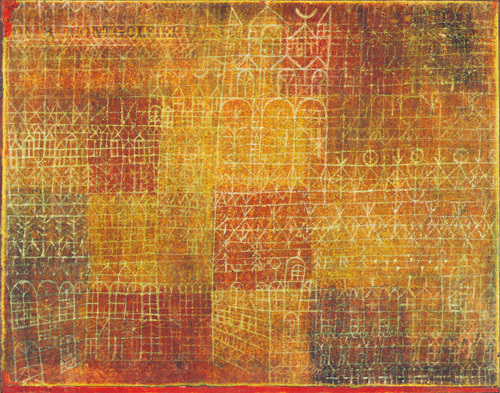
Klee, Paul. Cathedral. 1924, 138. Watercolor and oil washes on paper mounted
on cardboard and wood panel, 30.1 x 35.5 cm. The Phillips Collection,
Washington, D.C.
The Thinking Eye or any other book of Paul Klee, can not answer the question of what precisely the many symbols mean, but rather, they provoke the following issues: What essence is represented in this symbol? How did this sign come into being? What motivated its appearance? The responses to such a line of questioning shed a different perspective on his specialized interests.
The image of a fish provides examples. With fish in an aquarium, Klee might be representing the essence of space, for instance. In another picture, the image of a fish may have resulted from an exploration of organic structure. A fish could, in yet another painting, represent the idea of movement.
It seems obvious that the many recurring motifs and signs in Klee’s paintings do not constitute a cryptic message but are, in fact, representations of artistic investigation and truth.
The Thinking Eye is crucial to this type of understanding of Klee’s paintings, especially those completed during his tenure at the Bauhaus.
The Thinking Eye is useful for creating a condition of meaning and essence. The book do not offer direct answers about the meaning of Klee’s many symbols but rather provide a new, discursive way to explore them in his paintings of the Bauhaus years.
Anyone who really wants to provide a context for Klee’s production of his thinking eye and his symbol-dense paintings, the history of the Bauhaus needs to be considered.
The literature available on the Bauhaus itself and Klee’s affiliation with the school is extensive. To attempt to consult it all would not only be impractical but, more importantly, except for signaling out a few pertinent publications, a general survey of the literature would prove to be futile as it would detract from the investigation at hand. Instead, it is more prudent to weed through the literature, excise the irrelevant, and utilize only that which highlights the interchange between the philosophy and culture of the Bauhaus and Klee’s use of symbols.
How can the philosophy and culture of the Bauhaus be defined? A general history is needed but I will write another article about it. What we must keep in mind for now, is that the Bauhaus was founded by the architect Walter Gropius in 1919 and was dissolved by the pressures of the Nazi regime in 1933.
Cathedral painting example ( which for me, is really an Architectural Experiment) :
I am not going to delvin into the more complex architectural themes of Klee’s art, but just trace the formation of Klee’s ideas of architecture.
Early in his career, Klee displayed some interest in the subject of architecture, producing simple pen-and-ink drawings of familiar cityscapes. Soon he began to realize the potentiality of thinking architecturally.
During his year in Italy, Klee took special note of architecture and developed an interest in essentialized architectonic forms. Concentrating mostly on observed structural relationships, he wrote in his journal that, “now, my immediate and at the same time highest goal will be to bring architectonic and poetic painting into a fusion, or at least to establish a harmony between them.”
In a later diary he clarified the term “architectonic” and analyzed its effect on his development as an artist: « When I learned to understand the monuments of architecture in Italy, I won an immediate illumination. . . .Its spatial organism has been the most salutary school for me; I mean this in a purely formal sense. . .Because all the interrelations between their individual design elements are obviously calculable, works of architecture provide faster training for the stupid novice than pictures or
nature… Our initial perplexity before nature is explained by our seeing at first the small outer branches and not penetrating to the main branches or the truck. But once this is realized, one will perceive a repetition of the whole law even in the outermost leaf and turn it to good use. »
This new understanding of the formal relationships between parts and their whol allowed Klee to start exploring space in his art. It was not until after his trip to Tunisia, however, that these spatial concerns took on a truly architectural character. After returning from his sojourn on the northern African coast, where he began the synthesis of urban architecture and pictorial architecture,
Architectural thinking, in combination with architectural subjects, begins to appear more and more readily in Klee’s paintings. This new-found fascination with a new form of art can be seen in Klee’s adoption of architecture as a literal subject for his art.
However, it is Klee’s 1924 work Cathedral in combination with a close examination of Klee’s the thinking eye– that provides an bexemplary paradigm for exploring Klee’s inordinately close relationship to modern architecture and its concerns. As the title suggests, the watercolor and oil wash painting depicts a cathedral.
One can pick out a gallery with arches, a bay, vaulted ceilings, windows, and roof; all created with thin, light lines. Both the interior and exterior of the cathedral are shown concurrently. Visible are a tower and its roof, while (as if acting on the principles of transparency and temporality articulated by Giedion), the interior coloristic effects of stained-glass windows also present themselves at will. As the glass of the Dessau Bauhaus permits an interpenetration of the interior and the exterior, so too does Klee present his spectator with a conflation of time and space.
A certain affinity exists between Klee’s, Gropius’s and Giedeon’s thinking. Support for this can be found in Klee’s teachings, where he expresses, as Giedion did in Space, Time and Architecture, the need to move beyond central perspective: “It is only recently that we have been free to deviate from the rules [of perspective]. What do we gain by it? We gain the possibilities of spatio-plastic representation and movement that were limited under earlier methods.”
Klee is thinking in the same historical-minded way typical of Giedion, realizing how the more recent artistic experiments of the cubists and futurists have allowed the artist/architect to move beyond perspective and begin probing the relationships between time and space.
Furthermore, the “phenomenal transparency” called for by Rowe and Slutzky is also at work in Klee’s painting.
In Cathedral, the brightness and thickness of the lace-like lines vacillates ever so subtly between the forefront and the background of the picture plane. The bolder, brighter lines appear to be closer to the front while the lighter, duller lines to be farther towards the back of the pictorial space. Yet the density of each line does not remain the same.
For example, in one area of the painting a line may be bold but as it moves through the pictorial space it becomes duller and thinner.
It is impossible to decipher which line or form is closer and which is farther. The space is further complicated within the bottom left-hand corner where Klee utilizes orthogonal perspective.
Whereas the rest of the piece could be interpreted as flat (and almost purely decorative) the perspectival rendering of space forces the viewer to question the pictorial determinants of spatial arrangement to be able to decipher what precisely belongs to the foreground and what is part of the background. Without the emphasis on perspective, it would be easy to assume that the color wash comprises the ground upon which the lines lie. Yet as a copper patch of color advances, the wash becomes part of the foreground.
Foreground and background become interchangeable, if not abandoned altogether. Either way, there is a definite shifting in space throughout the work. With Cathedral, Klee presents the “simultaneous perception of different spatial locations” necessary for “phenomenal transparency” by playing with the viewer’s perception of the pictorial space.
In the consideration of Rowe and Slutzky’s paradigm (references to study for who wants to know more) , Klee would appear to move beyond the “literal transparency” of Giedion and enter the field of “phenomenal transparency” as the painting Cathedral clearly demonstrates. The vagueness of the term “phenomenal transparency” however, raises other concerns that resonate in Klee’s painting. Rowe and Slutzky never offer a precise definition of their term “phenomenal transparency.”
The closest they come to providing an explanation is in the second part of their discourse where they explain that “phenomenal transparency might be perceived when one plane is seen at no great distance behind another and tying in the same visual direction of the first.”
This insistence on planes is emphasized with their discussions of buildings designed by Le Corbusier in particular, specifically his villa at Garches. Le Corbusier accomplishes Képes’s goal of interpenetration “without optical destruction” through the play of glass and concrete planes. Between the parallel planar surfaces a tension is created that implies interpenetration without the translucent effects of the glass curtain of the Dessau Bauhaus.
If planes are required for “phenomenal transparency,” then the “phenomenal transparency” of Cathedral must be called into question. There are no parallel planes to be found in the painting that would correspond to this critical structural emphasis in Le Corbusier’s building. Instead, the way in which Klee conceives of planes can be surmised in his teachings.
For the artist, planes are formed through the tension between passive lines. As discussed previously, the lines in Cathedral are, by contrast, in a subtle, but constant motion; they shift through the pictorial space and cannot, as a result, constitute planes.
The planes that can be found in Cathedral are neither parallel to each other nor to the picture plane; they are arranged perspectivally. Here Klee’s pedagogy is highly instructive. The articulation of “perspective horizontal planes” and “perspective vertical planes” in The Thinking Eye describes specific configurations of shapes found in several places in the painting.
Although it might be possible to argue that these “planes in perspective” are parallel to one another (after all, they occur in bands), nonetheless the “planes in perspective” are formed by lines that seem to connect to one another, making it impossible to tell where one plane ends and the next begins. As a result, one cannot decipher which planes are “perspective horizontal planes” and which are “perspective vertical planes”.
Therefore, one cannot determine whether the planes are parallel to one another. Certainly, planes are depicted in Cathedral, but by looking at these forms in combination with Klee’s pedagogy, it becomes clear that they function in a very different way than they do in Le Corbusier’s buildings.
The question then arises: Does Cathedral work within the “phenomenal transparency” paradigm described by Rowe and Slutzky?
The word “phenomenal” implies something that is known through the senses; it comes from a Greek word phainesthai meaning “to appear”. From simply looking at Cathedral, Klee comes to reveal his phenomenal world: the image is imbued with the sensual effects of being in a cathedral. Arch and window shapes consume the picture; lines weave and overlap as do the many delicate features of a Gothic cathedral; a restrained luminosity recalls the effects of stained glass windows. Notwithstanding this reading, Klee rejects the fascination with the phenomenal. As shown by his lectures, appearance is merely a consequence of creation, not the goal. Form as phenomenon is a dangerous chimera. Form as movement, as an action, is a good thing, active form is good. Form as rest, as end, is bad. Passive, finished form is bad. Formation is good. Form is bad; form is the end, death.
Formation is movement, act. Formation is life. . .and the sections must fall into a definite structure; with all their widening development, one must be able to encompass them at a singe glance.
It seems then that Klee, by the example of Cathedral, rejects the pervading notions of spatial conception that concerned modern architects of his era. Instead of an interest in the “literal transparency” of Giedion or the “phenomenal transparency” of Rowe and Slutzky, Klee is concerned with spiritual (and not material) transparency. “Spirit” at its root means “breath” and implies a certain ineffable immateriality. Klee’s sketch of “the three dimensions combined in cube” bears a striking resemblance to line configurations found in Cathedral.
That the cube itself is omitted in the space renderings in Cathedral implies the immaterial nature of the work; never is the viewer presented with the appearance of a structure (the phenomenal) but rather the fundamental essence of a structure (the spiritual).
Klee worked in the spiritual realm through an exploration of the dynamic element. A concern with dynamism certainly occupied modern architects; the need for shifting perspectives and other movements in space has already been discussed in some depth. However, such architectural thinking failed to enter into the spiritual realm, which was an equally viable quest in modern art, and therefore modern architects could not reach their goals: “Pure dynamic action within a limited sphere is only possible on the spiritual plane.
To go even further, it may be that Klee is rejecting architecture altogether, or at least he
seems to be responding directly to the Bauhaus’s elevation of architecture as the ultimate goal of artistic training. He states: « Our means of investigating natural structures by means of cross-sections and longitudinal sections is no doubt applicable to architectural structures, but we should never find an example in which ground-plan and elevation were not undamentally different. Which again means that there is no example of the purely dynamic in this field. Consequently we must situate architectural works in the purely static sphere, though there may be a certain inclination towards the dynamic. . .in the more ideal realms of art, such as painting, the greatest mobility of all is possible, an actual development from the static to the dynamic. »
It is impossible to know if Klee is truly rejecting the supremacy of architecture at the Bauhaus; in the end, Klee’s personal attitude toward this hierarchy is of little consequence. What remains important, however, is the re-thinking of space and the artist’s engagement with spatial experiments. Through the examination of Sigfried Giedion’s Space, Time and Architecture and Colin Rowe’s and Robert Slutzky’s essays on “phenomenal transparency,” one discovers that alongside Klee’s works such as Cathedral and others point much more clearly to Klee’s investigation of space in architectural terms.
At the very least, we can begin to recognize that Klee was working with the very same spatial goals as modern practicing architects and contemporary architectural theorists. What follows then is an exploration of Klee’s use of certain symbols in his paintings that constitute a kind of architectural experiment.
I myself still wonder why we don’t teach Klee in Architecture schools.
 Selbstwehr
You must be logged in to post a comment.