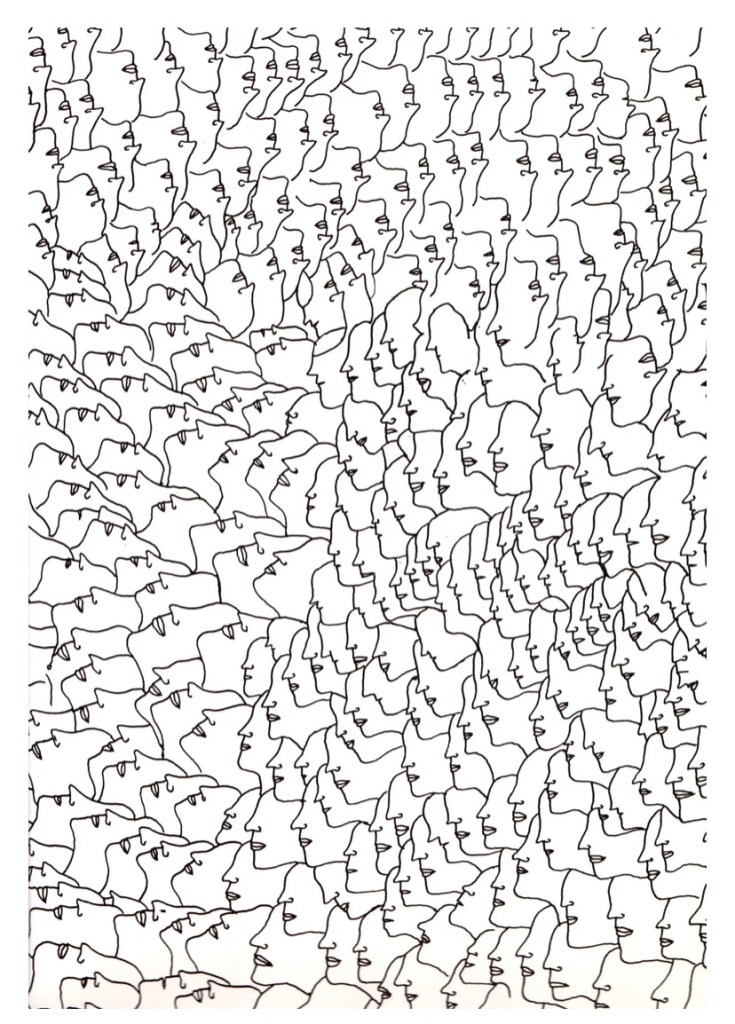
Everyone becomes a creator, there is a general mobilization that leads to the paradox where there is no longer a recipient, everyone is a transmitter. Everyone creates their own expression and no longer has time to listen to others. It is an excessive form in which art disappears due to excess, not due to lack, creating a short circuit to the same sense.
“Where are your dreams? …(…) What have you done with those years? Where have you buried your best moments? Have you really lived? ”― Fyodor Dostoevsky, White Nights.
« Une des caractéristiques de l’art de Vermeer, comme peut-être de tout art, parvenu à un certain degré de noblesse, est de peindre des choses, et non des événements. Le monde que perçoit Vermeer n’est pas celui, muet à jamais, des événements insignifiants, mais celui de la matière, éternellement riche et vivante. L’anecdotique, pourrait-on dire, y a chassé l’anecdotique : le hasard d’un moment de la journée, dans une pièce où rien d’important ne se passe, apparaît comme l’essentiel d’un réel dont les événements apparemment notables constituent au contraire la part accessoire. De ce réel saisi par Vermeer le moi est absent, car le moi n’est qu’un événement parmi d’autres, comme eux muet et comme eux insignifiant. Il n’y a d’ailleurs pas d’autoportrait de Vermeer, et la biographie du peintre tient en dix lignes anodines. Cependant Vermeer semble bien s’être peint une fois, par un jeu de double miroir : dans cette toile sans nom précis, aujourd’hui appelée L’Atelier. Mais le dos, comme un peintre quelconque, qui pourrait être n’importe quelle autre personne occupée à sa toile. Rien, dans le costume, la taille, l’attitude du peintre, qui puisse être regardé comme signe distinctif, rien donc qui fasse état d’une complaisance quelconque du peintre à l’égard de sa propre personne. Dans le même temps cet « atelier », comme toutes les toiles de Vermeer, semble riche d’un bonheur d’exister qui irradie de toutes parts et saisit d’emblée le spectateur, et qui témoigne d’une jubilation perpétuelle au spectacle des choses : d’en juger par cet instant de bonheur, on se persuade aisément que celui qui a fait cela, s’il n’a fixé dans sa toile qu’un seul moment de sa joie, en eût fait volontiers autant de l’instant d’avant comme l’instant d’après. Seul le temps lui a manqué pour célébrer tous les instants et toutes les choses » . Cl. Rosset, Le réel et son double.
We have aged not only in years but in terms of goals to be achieved. We have reached the limits of time, thousands have shaken the barriers. The time has come to moderate. We have discovered the lie of spring’s pale extinction, and our wounded hands testify to the invalidity of the last walls. But we don’t have to send our poor dreams like doves of peace over that tape; they won’t return. We need to be men. We need eternity, because only this gives space for our gestures; even knowing we are in a narrow sadness. Within such limits we have to create an infinity, since we no longer believe in extinction. We don’t have to think about the large, flourishing country, but remember the walled garden, which also has its infinite: summer. Please help us in this work. Creating a summer, this is what we need. … We are no longer naive: but we have to force ourselves to become primitive, to be able to start with those who really are. We have to become creatures of spring to reach the summer to be announced in its splendor. No coincidence, whim or fashion has brought us back to Raphael’s predecessors. We are the distant heirs called to many heirs. I would always like to tell someone (I don’t know to whom): “Don’t be sad”. This is for me like an intimate confession to be pronounced softly, slowly, in a deep twilight.
Once dead decomposition will begin with having to get rid of all the physical garbage left behind since the first day; splitting its territory into waste and compost, mindlessly waiting a long time on a bench for some dark edges of memory, the black needle in the haystack, contemplating the spores flying in the fog. Task accomplished of becoming an ant or honey, being reborn as a man in the middle of the desert, carving out a salvation for the soul as quickly as possible. Spiritual work ad aeternam finding the virgin angle from which to justify the decomposition, hearing the brilliance of the flint in the fire. Waking up, making clay. From the grain of salt of once sweat, erect the dam against the disbelievers and the mourners (among whom you unfortunately recognize those you love).
The world enters us and departs, just as language and image and idea are imprinted upon our consciousness, considered, forgotten, passed on, released.
In the meantime leave nothing to chance, to rickety episodes: to make the deep cellars transparent, to experiences, to the possibilities of humanity, for a new humanity.
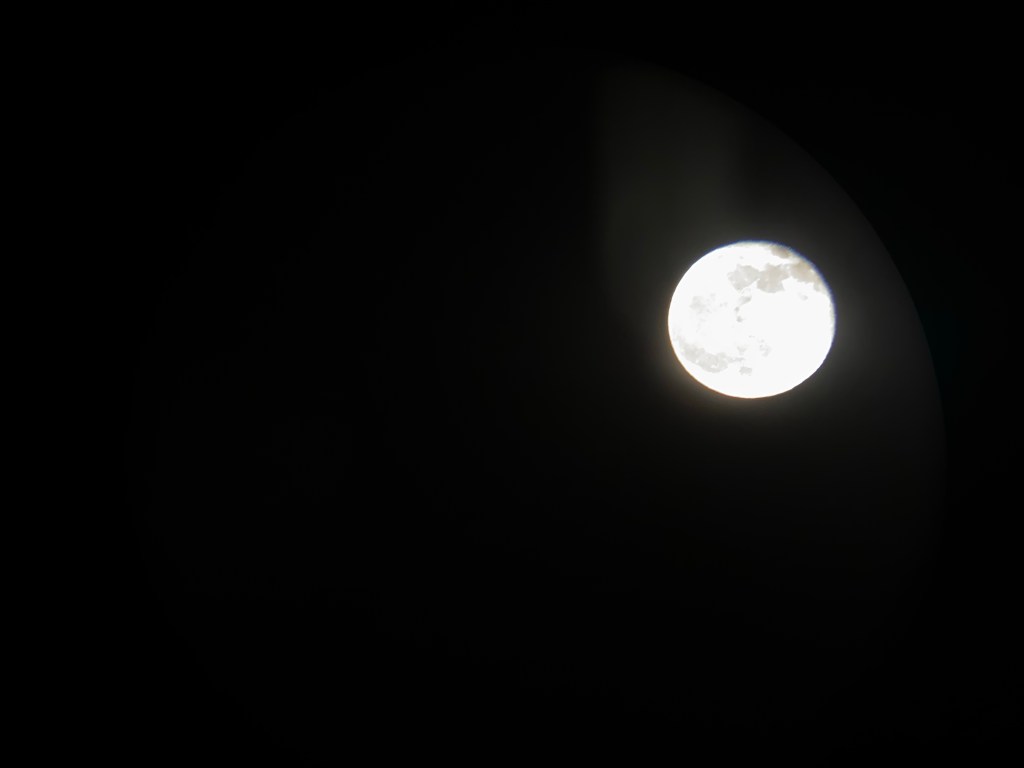
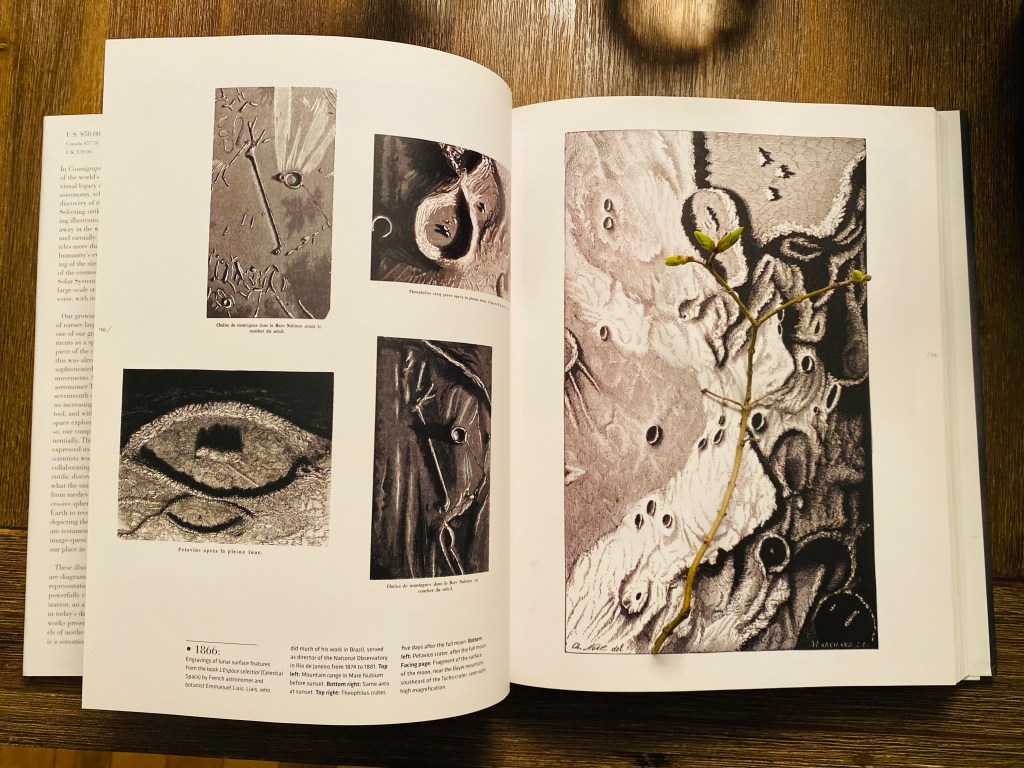
Passover Moon 2022 seen with a Celestron telescope.
“At least 2 billion Earth-sized planets are believed to be habitable in our galaxy,” according to a study published by the American Academy of Sciences.
“This morning, after hearing an astronomer talk about billions of suns, I gave up washing myself: why wash again? » Cioran.
“When the Baal Shem Tov, the founder of Hasidism, had a difficult task before him, he would go to a certain place in the woods, light a fire and meditate in prayer—and what he had set out to perform was done. When a generation later the “Maggid” of Meseritz was faced with the same task he would go to the same place in the woods and say: We can no longer light the fire, but we can still speak the prayers-and what he wanted done became reality.
Again a generation later Rabbi Moshe Leib of Sassov had to perform this task. And he too went into the woods and said: We can no longer light a fire, nor do we know the secret meditations belonging to the prayer, but we do know the place in the woods to which it all belongs–and that must be sufficient; and sufficient it was.
But when another generation had passed and Rabbi Israel of Rishin was called upon to perform the task, he sat down on his golden chair in his castle and said: We cannot light the fire, we cannot speak the prayers, we do not know the place, but we can tell the story of how it was done.
And, the story which he told had the same effect as the actions of the other three.” Gershom G. Scholem.“ Schocken Books, 1954.
Far from the air breathed by noisy people, the distance separates you from the surfaces, it does not cover any of them, you have finished walking the labyrinth, circulating in the architectures, tasting its lines of flight, colliding with its angles, sliding through the programmed virtual circuits of the past where others tell you, you drive, the leaves of the trees hollow out in pockets of wind, you forget the road, only let the water gathers you.
The earth,the wind fall and flow, the water gathers, the water rises, the water rises in silence, connects night to day, grows on the horizon, the water trembles the wind, suspends the round flights, wrinkles the clouds, water collects the remaining crashes of frosts and blazes, water disperses the wandering flowerless flowers, water collects the weary clouds and the sweat of the earth, water recomposes the lost colonies, the water loses memory and marries all forgetfulness, the rain falls, the water wriggles, dazzles as far as the eye can see, the water cracks, springs up in the caves, gleans the seeds, takes shelter in the fruits, water will not extinguish the fire, water will prefer the night.

 Selbstwehr
You must be logged in to post a comment.