• About

Selbstwehr

~ Art as self defense

Tag Archives: Yehuda Amichai

Mythopoeic Imagination

26 Friday Feb 2021

Posted by S/O in Amichai Yéhuda, Concepts

≈ 1 Comment

Tags

Mythopoeic, Yehuda Amichai

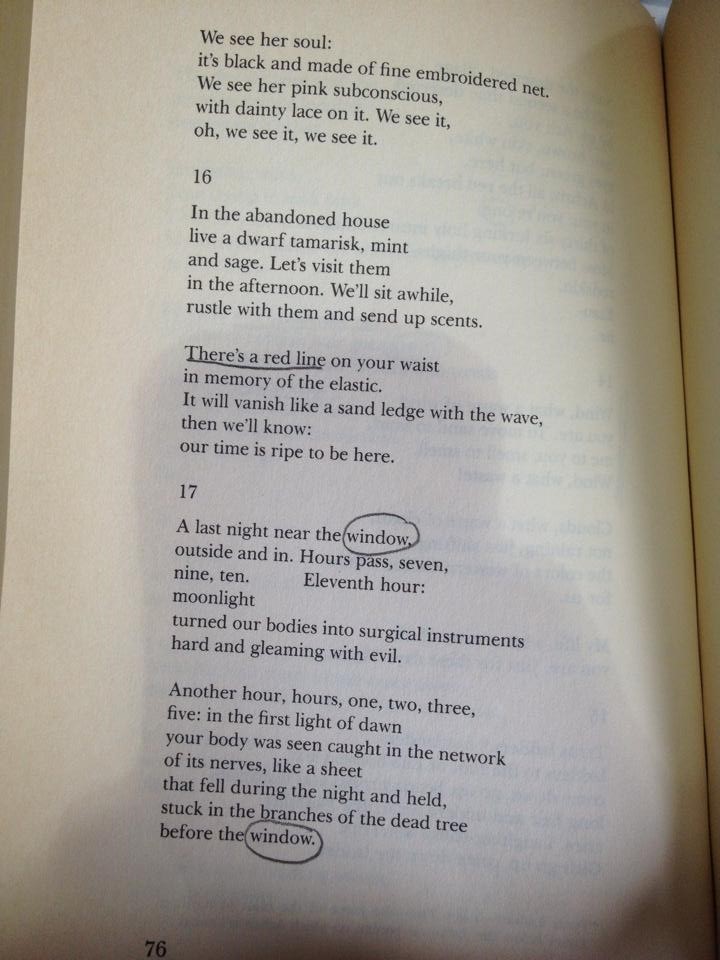
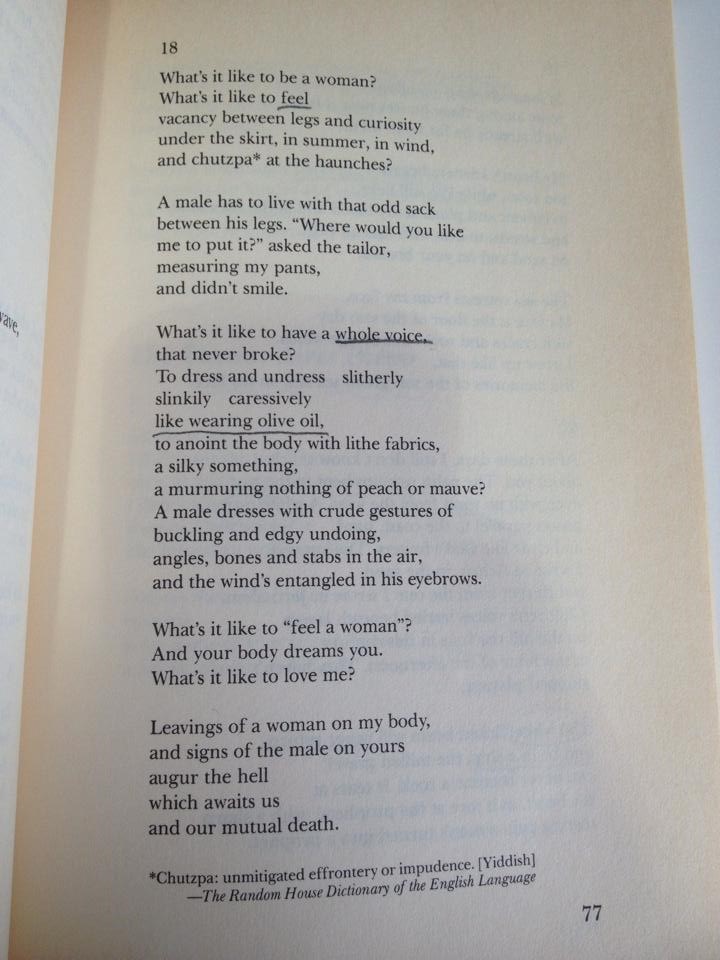
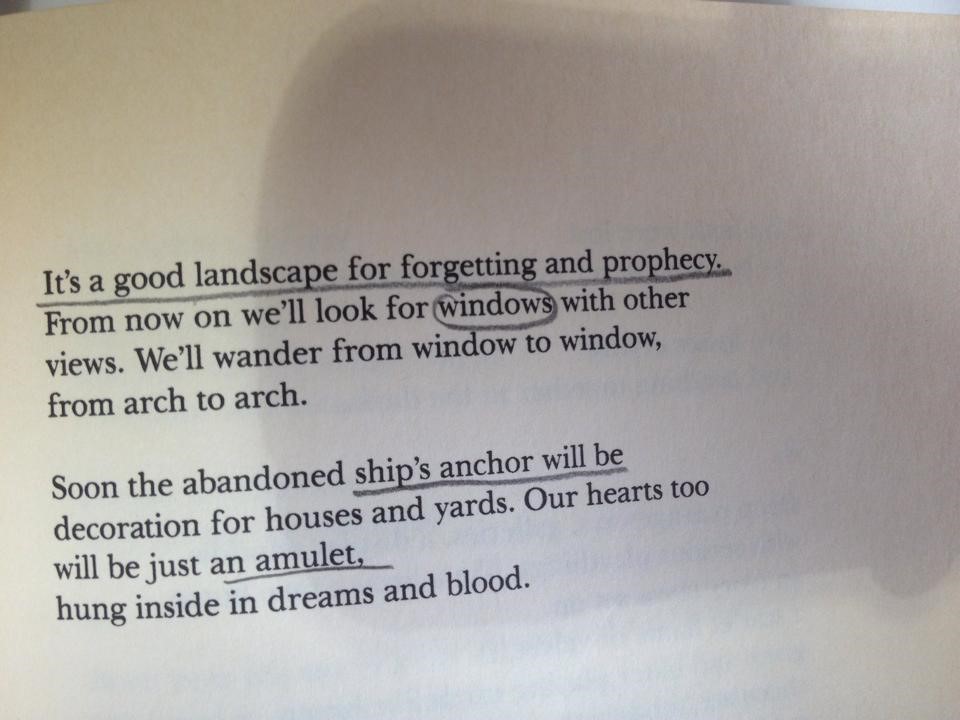
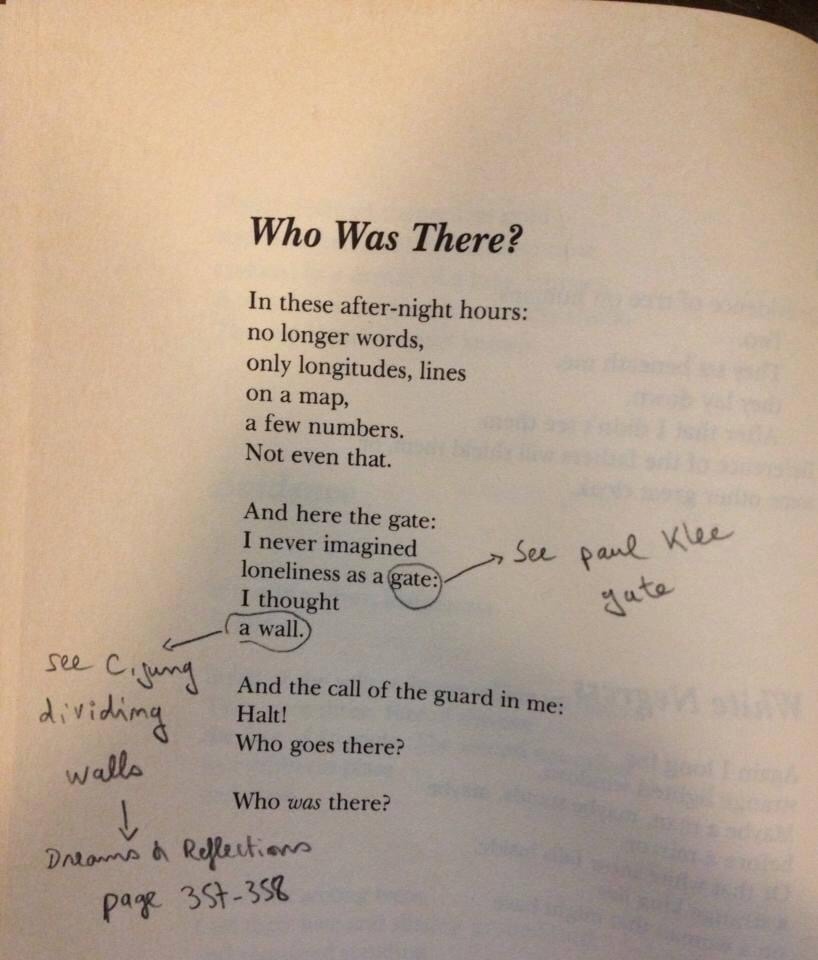
Yesterday I was reading poetry and annotating some unconscious images which sometimes I found insane. But I just come to realize that those images are the matrix of a mythopoeic imagination which has vanished from our rational age.

They are uncertain paths that lead into the depths of me (or you) …. And I remember Goethe’s words : “now let me dare to open wide the gate / Past which men’s steps have ever flinching trod.” Or the second part of Faust too, was more than a literary exercise, it’s a link in the Golden Chain of Homer, which has existed from the beginnings of philosophical alchemy down to Nietzsche’s Zarathoustra.

It’s really an unpopular and dangerous voyage of discovery, particularly at this time when I needed a point of support in this world and I may say that my family and my professional work were that to me. It was most essential for me to have a normal life in the real world as a counterpoise to that strange inner world.

My family and my profession remained the base to which I could always return, assuring me that I was an actually existing, ordinary person.

Nietzsche had lost the ground under his feet because he possessed nothing more than the inner world of his thoughts–which incidentally possessed him more than he it. He was uprooted and hovered above the earth, and therefore he succumbed to exaggeration and irreality.

For me, such irreality was the quintessence of horror, for I aimed, after all, at this world and this life. No matter how deeply absorbed or how blown about I was, I always knew that everything I was experiencing was ultimately directed at this real life of mine. I meant to meet its obligations and fulfill its meanings.

Share this:

  • Click to share on X (Opens in new window) X
  • Click to share on Facebook (Opens in new window) Facebook
Like Loading...

Forever North (Just as it was by Yehuda Amichai)

02 Wednesday Dec 2020

Posted by S/O in Amichai Yéhuda

≈ Leave a comment

Tags

Oblivion Verses, Shigeru Umebayashi, Thomas Bernhard., Yehuda Amichai, כמו שהיה יהודה עמיחי

When we think, we know nothing, everything is open, according to Roithamer. The nature of things is always different, according to Roithamer. First, the cone has views in all directions, then the cone has views only to the south and north, then west and east, and finally only north. Thomas Bernhard.

Share this:

  • Click to share on X (Opens in new window) X
  • Click to share on Facebook (Opens in new window) Facebook
Like Loading...

יהודה עמיחי -מסעות בנימין האחרון מטודלה

18 Thursday Feb 2016

Posted by S/O in Amichai Yéhuda, Uncategorized, יהודה עמיחי

≈ Leave a comment

Tags

Benjamin of Tudela, Yehuda Amichai, יהודה עמיחי‎

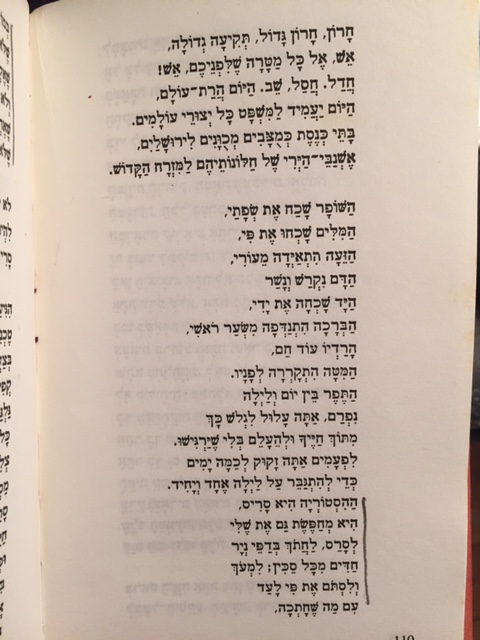
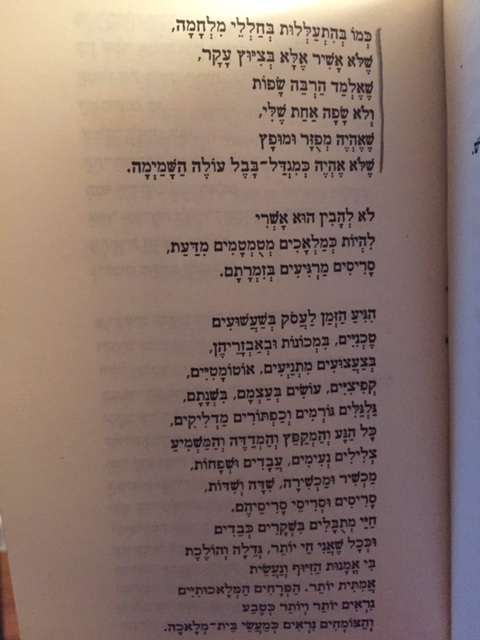
FullSizeRenderFullSizeRender(1)

Translation of the marked section:

“History is enough

it’s looking for mine too

to castrate, to cut off with papers pages

sharper than any knife; to crush

and to stuff my mouth forever

with what it cut off

as in the mutilation of war-dead

so that I won’t sing except in a sterile chirp

so that I will learn many languages

and no one of them mine

so that I will be scattered and dispersed.”

Y. Amichai


Share this:

  • Click to share on X (Opens in new window) X
  • Click to share on Facebook (Opens in new window) Facebook
Like Loading...

Instead of love poem – Yehuda Amichai

29 Sunday Nov 2015

Posted by S/O in Amichai Yéhuda, Uncategorized

≈ 1 Comment

Tags

Love poems, Yehuda Amichai

From “thou shalt not seethe a kid in its mother’s milk”

they made the many lawas of Kashrut

but the kid is forgotten and the milk is forgotten and

the mother is forgotten.


In this way from “I love you”

we made all our life together.

But I’ve not forgotten you

as you were then.

Yehuda Amichai


Share this:

  • Click to share on X (Opens in new window) X
  • Click to share on Facebook (Opens in new window) Facebook
Like Loading...

Throw this land, one at the other, But the land always falls back to the land

25 Wednesday Nov 2015

Posted by S/O in Amichai Yéhuda, Aviation, Uncategorized

≈ Leave a comment

Tags

Yehuda Amichai

okkkk

Hebrew writing and Arabic writing go from east to west,
Latin writing, from west to east.
Languages are like cats:
You must not stroke their hair the wrong way.
The clouds come from the sea, the hot wind from the desert,
The trees bend in the wind,
And stones fly from all four winds,
Into all four winds. They throw stones,
Throw this land, one at the other,
But the land always falls back to the land.
They throw the land, want to get rid of it.
Its stones, its soil, but you can’t get rid of it.
They throw stones, throw stones at me
In 1936, 1938, 1948, 1988,
Semites throw at Semites and anti-Semites at anti-Semites,
Evil men throw and just men throw,
Sinners throw and tempters throw,
Geologists throw and theologists throw,
Archaelogists throw and archhooligans throw,
Kidneys throw stones and gall bladders throw,
Head stones and forehead stones and the heart of a stone,
Stones shaped like a screaming mouth
And stones fitting your eyes
Like a pair of glasses,
The past throws stones at the future,
And all of them fall on the present.
Weeping stones and laughing gravel stones,
Even God in the Bible threw stones,
Even the Urim and Tumim were thrown
And got stuck in the beastplate of justice,
And Herod threw stones and what came out was a Temple.

Oh, the poem of stone sadness
Oh, the poem thrown on the stones
Oh, the poem of thrown stones.
Is there in this land
A stone that was never thrown
And never built and never overturned
And never uncovered and never discovered
And never screamed from a wall and never discarded by the builders
And never closed on top of a grave and never lay under lovers
And never turned into a cornerstone?

Please do not throw any more stones,
You are moving the land,
The holy, whole, open land,
You are moving it to the sea
And the sea doesn’t want it
The sea says, not in me.

Please throw little stones,
Throw snail fossils, throw gravel,
Justice or injustice from the quarries of Migdal Tsedek,
Throw soft stones, throw sweet clods,
Throw limestone, throw clay,
Throw sand of the seashore,
Throw dust of the desert, throw rust,
Throw soil, throw wind,
Throw air, throw nothing
Until your hands are weary
And the war is weary
And even peace will be weary and will be.

Yehuda Amichai


Share this:

  • Click to share on X (Opens in new window) X
  • Click to share on Facebook (Opens in new window) Facebook
Like Loading...

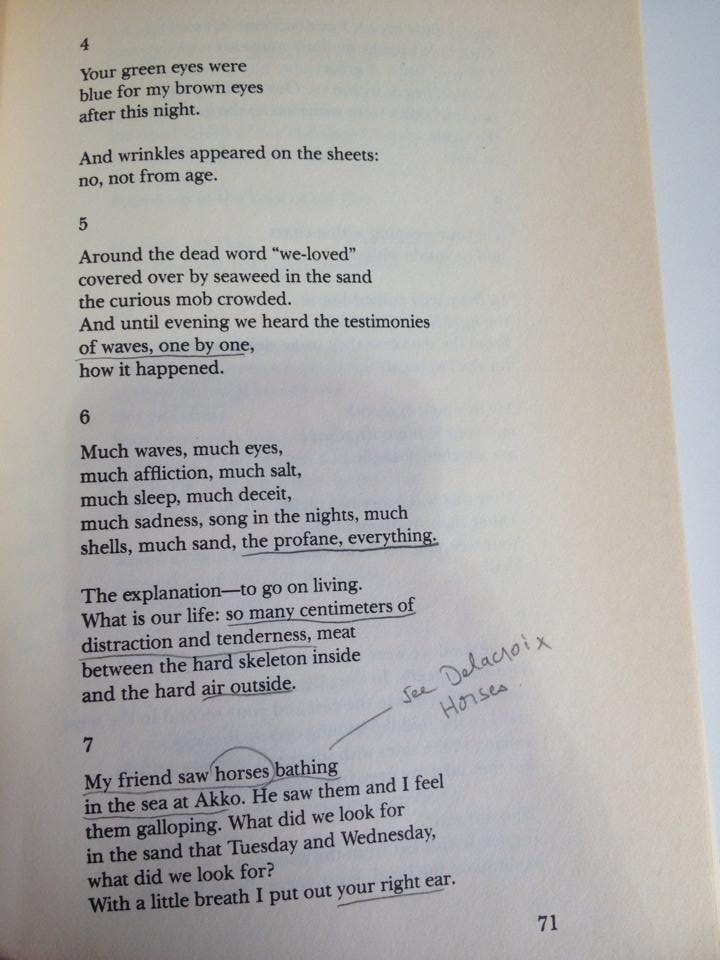
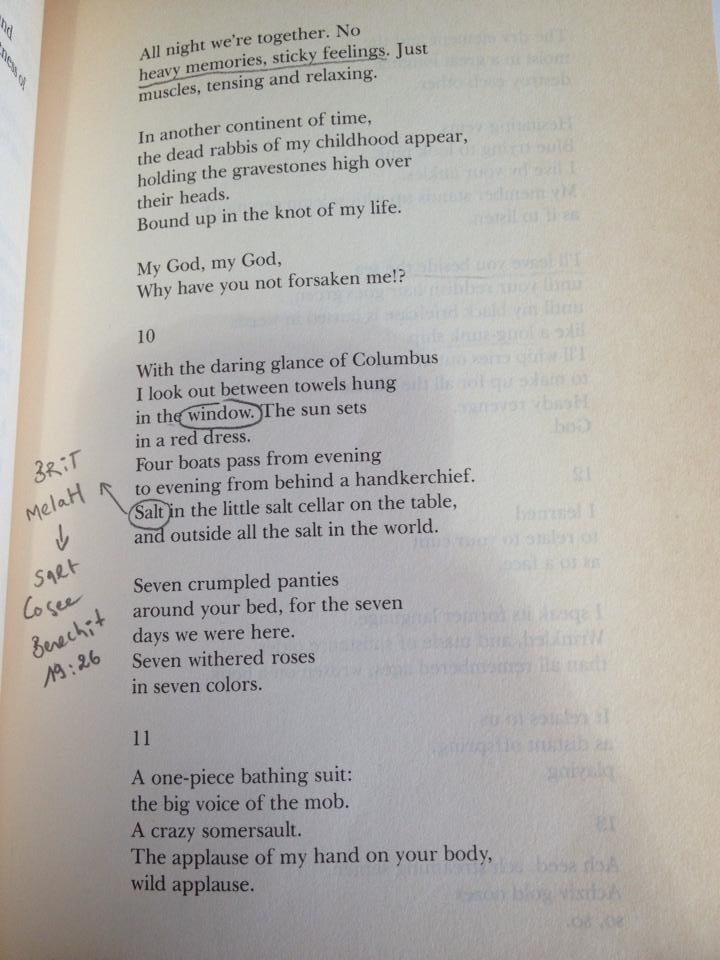
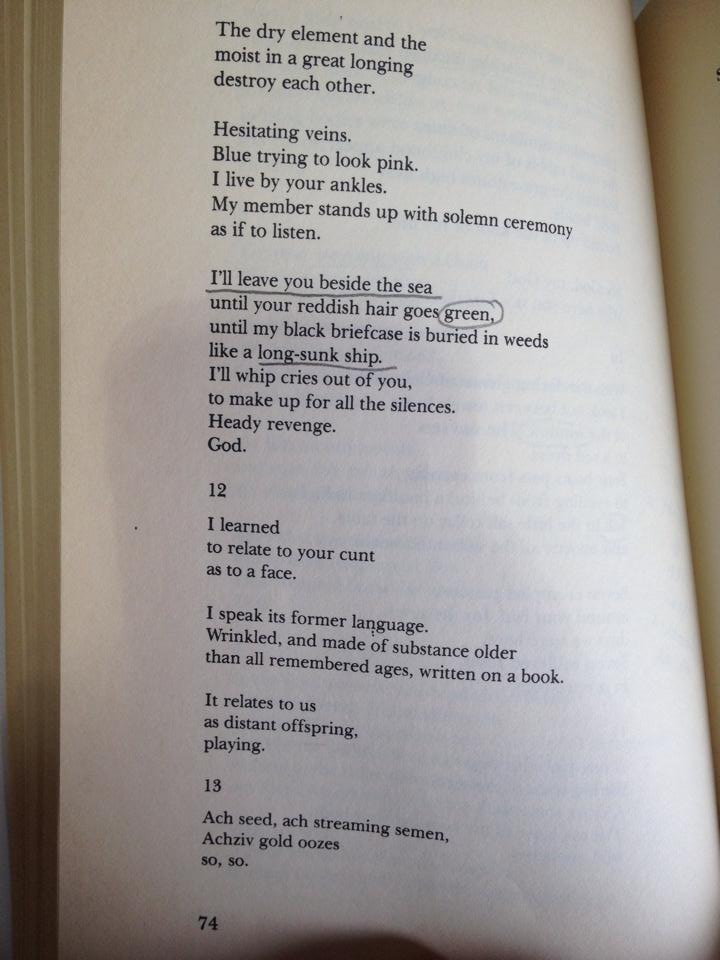
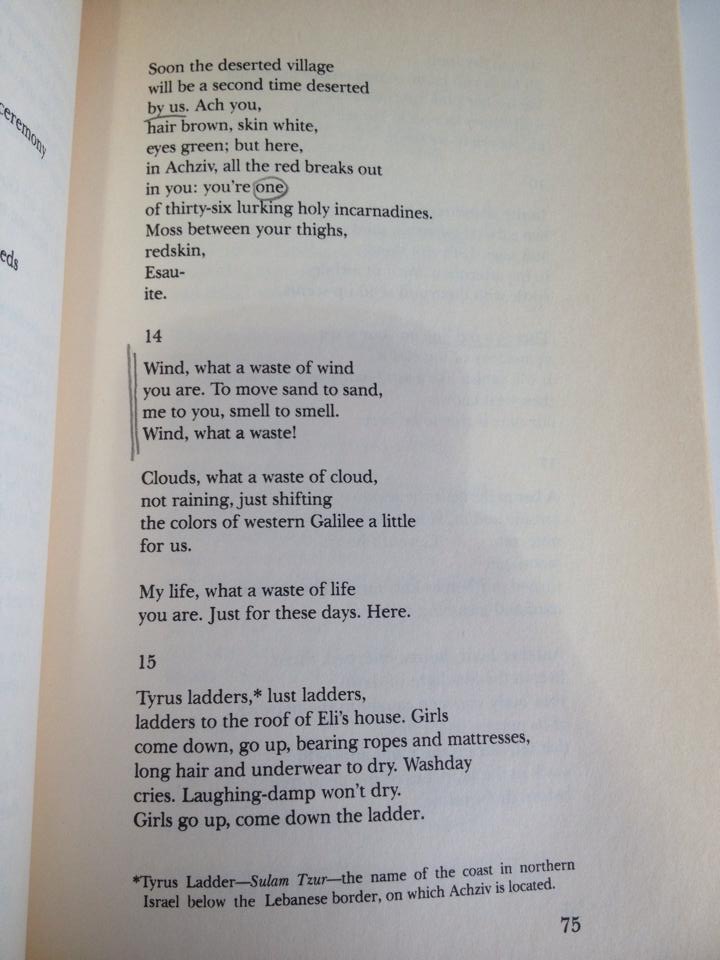
Achziv Poems-Yehuda Amichai

12 Thursday Mar 2015

Posted by S/O in Amichai Yéhuda, Uncategorized

≈ Leave a comment

Tags

Achziv, Yehuda Amichai

בשבילך

1 23 4 5 6 7 8 9 9 11

Share this:

  • Click to share on X (Opens in new window) X
  • Click to share on Facebook (Opens in new window) Facebook
Like Loading...

Yehuda Amichai’s obsession

03 Tuesday Mar 2015

Posted by S/O in Amichai Yéhuda

≈ Leave a comment

Tags

Yehuda Amichai

514hZf-PMuL._SY344_BO1,204,203,200_ (1)

Jean Paul Sartre: “It’s quite an undertaking to start loving somebody. You have to have energy, generosity, blindness. There is even a moment right at the start where you have to jump across an abyss: if you think about it you don’t do it.”

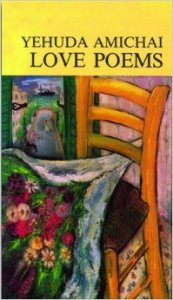
When I first started reading Amichai’s poetry I would structure it in any way that felt right. It was quite arbitrary really. Once I reached the half of it, I stopped and took a second look at the poem I just read and asked myself: is there an underling structure here? This is what I came up with.

Each poem in “Amichai’s love poetry” is representing a different image of the lovers; they are like two associations in one mind, as he is referred to, so is she, they are like two lightbulbs in a lamp, each one alone too dark but together lighted they are a festival of light; she is the walled public garden of the city and he the road which moves away from her. They are like two stones at the bottom of a hill, secluded and alone, they are two numbers standing alone and combining; he is like soft water in a pipe, waiting to be summoned by the turning of conceits, affirm the isolated perfection of love. Amichai has this stunning obsession of cutting everything into two.

The couplets which owe something to “Metaphysical” conceits, affirm the isolated perfection of love, yet even at their most serene the lovers are separate entities, two lightbulbs, two stones, two numbers. The poems offer an apparent affirmation of love, yet separateness and isolation are implicit in them.

The “Ahavah be emet” (true love) , the coupling of both spirit and flesh is still undiscovered and it is only for a brief moment that the bulbs achieve a festival of light, unbounded unity in each other. Love has proof in continuity and real love perhaps in eternity, yet the nature of Amichai’s conceits confirms only its uncertainty and brevity.

The poet suggested in “God has pity on kindergarten children” that only true or real lovers may be worthy of God’s grace. The notion of separateness offered by the couplets in “Pine cones” implying that the lovers have failed to achieve perfect unity, indicates their separation also from God.

Lack of completeness is hinted; on the surface the stories are idyllic expressions of love framed by staples of romantic convention, rain, sun, spring, flowers, grass, and the full moon. The woman’s body is “full of lizards, they all love sun” her eyes, breasts and things compose the sensual picture and complement the earth images providing the cycle’s setting. On the surface, peace and tranquility accompany unconditional and perfect love, yet notes of unease penetrate the harmony of body and nature, the hint of conflict about what is only an act of love, not perfect love itself:

“Your heart plays blood-catch

In your veins

Your eyes are still as warm as beds

Time has been lying in

Your thighs are two sweet yesterdays

I’ll come to you

All 150 psalms

Roar at once”

Human love cannot save the lovers from the terrible trial because it is never more than transitory and even though it may hasten the salvation of the world which is an idea Amichai expresses in later poetry, salvation will not be extended to the lovers. Attempts to fix love within a solid and protective frame usually fail.

Images of enclosure occur throughout all Amichai’s love poetry. Solid controlled images which have their place in a defined environment: the public garden is walled, the road is in a city, the water in a pipe, the numbers occur in their framework of arithmetical sums, the bulbs are part of a lamp.

Amichai’s images, rather, echo the phrase from a legal contract “together and severally” which he transposed to serve as the refrain for one of his early love poems ‘’both of us together and each alone” his walled garden, Noah’s ark, a box, a house: all suggest a safe bolt-hole in some guarded space, far away from the attempts of God and man to disturb the lovers. Isolation enclosure and secrecy are the necessary ingredients for love.

Real love in the sense of love that survives separation, that is not a breach but in Donne’s words an expansion is hardly a factory in the lyric of the “I“ experience.

“If we won’t stay together we won’t stay at all; even more so we won’t love”.

Society, social duty and identity take on the implicit guise of “them” those that break into love’s dwelling with love consequently unable to survive the social and spiritual environment in which the “ I “ is placed.

The intruding force remains unspecified: it is partly war, partly social duty, but there is more: we are led once again to the notion of “mixture” which dominates the love poetry: Eros and the world of faith cannot coexist, human love is unable to resist the onslaught of guilt.

If guilt is taken to be part of them, the intruders and destroyers of love, then they symbolizes not only the practical burdens of social duty but also spiritual obligations , God and his deputies, angels and the father, upon all of whom responsibility for moral vigilance has been placed:

“In the sand we were two headed Cerberus

With bared teeth, in the afternoon

Your one leg was in the east and the second in the west

With me in the middle, crouched on my forelegs

Suspiciously looking from side roaring terribly

To warm them off my prey”

The ephemerality of love is captured in words suggesting illusion or transience. Yet the poem presents lost of objects, trivial but real, as a contrast to these signs of transience, nipples, buckles, feathers and so on. These objects define the love more effectively than the words of passage, without necessarily bearing any relationship to each other, but together creating a context for love. Each object carries its own significance as part of love, each to be recalled as an association of it or a spur to memory.

Similarly words and phrases offer not a description but an impression of the woman, her changing and contrary faces and her evanescent nature of which a part is mirror the key to the notion of illusion.

The very nature of love is an illusion for the lovers, sing together the incomprehensible abandoning the decipherment of the real to the enjoyment of whatever they are able to possess.

Amichai’s contrasting of words and body compliments the juxtaposition of unchanging concrete objects with the woman and with love, both of whose nature constantly changing. The very ephemerality of love is due to its foundation on words, rather than the body. Spoken words shift and pass like sand, while writing is a concrete as the objects listed. If there is no love there is no writing, and without the involvement of bodies there is no love.

I think there is a clear distinction between great love poems and poems of great love.  I mean Amichai’s poems are the latter kind because love itself is their subject, albeit love which is sought, imagined, idealized or delusory, its greatness only potential or possible.

The “I “does not speak to the beloved in the sense of courtship or flattery. The female partner is described through extravagant images but they serve often to distance her, as if the hyperbole dehumanizes rather than endears her.

More often than not it is her body which is described but she remains faceless and nameless.

The overt sexuality of many of the body images indicates that she is little more than a means towards some kind of self-realization on the part of the lover.

Rarely is the woman transmitted to us as an object of deep affection, more often she is an adversary stronger that he, to be overcome not only by physical love but by the lover’s need for an even more exalted experience.

More importantly, the poetry seems to be aspiring toward a concept which can be defined as “true love” following Amichai’s own reference to “ha ohavim be emet” in God has pity on kindergarten children.

The idea of “be-emet” (Truly)  in relation to love “actual” real or perhaps great love , the nature of which he does not clarify, seems to refer to an emotional transcendence which endows the lovers with the security of a special kind of knowledge, of perception that survives the material pressures of their live:

“But perhaps he will pity those who love truly

And care for them

And shade them

Like a tree over the sleeper

On the public bench’’

They never attain the higher reality of “real love” however the love represented in the poetry can be passionate, satisfying, hopeless, disappointing, exalted or ecstatic but it does not provide unity of the souls with the unity of bodies, nor a marriage of true minds, this projected unity is alluded to in a poem in which the lover describes how “ we were such a good and loving invention” / “an airplane made from man and wife”/ “wings and everything” /etc.

Generally, however the love described in not purified or endowed with grace, nor does it assure the lovers of immortality. Whatever is meant by “ Ahavat be emet” (true love) , the lover do not achieve it and what they do possess, according to the poetry is insufficient, Amichai’s love poetry offers not an affirmation of true love only speculation as its nature and a consuming need to experience it.

Without this kind of love, the true love, the union of Amichai’s lovers is that the bodies only, any other view of love apart from the shadowy notion of real love approaches the dangerous territory of the spirit of faith.  He rejects the possible allegory.

I think reading Amichai’s love poems brought me back to my favorite movie “ Wings of desire” by Wim Wenders, I’ve always knew that this kind of true metaphysical love requires a jump:

“Now it’s serious. At last it’s becoming serious. So I’ve grown older. Was I the only one who wasn’t serious? Is it our times that are not serious? I was never lonely neither when I was alone, nor with others. But I would have liked to be alone at last. Loneliness means I’m finally whole. Now I can say it as tonight, I’m at last alone. I must put an end to coincidence. The new moon of decision. I don’t know if there’s destiny but there’s a decision. Decide! We are now the times. Not only the whole town – the whole world is taking part in our decision. We two are now more than us two. We incarnate something. We’re representing the people now. And the whole place is full of those who are dreaming the same dream. We are deciding everyone’s game. I am ready. Now it’s your turn. You hold the game in your hand. Now or never. You need me. You will need me. There’s no greater story than ours, that of man and woman. It will be a story of giants… invisible… transposable… a story of new ancestors. Look. My eyes. They are the picture of necessity, of the future of everyone in the place. Last night I dreamt of a stranger… of my man. Only with him could I be alone, open up to him, wholly open, wholly for him. Welcome him wholly into me. Surround him with the labyrinth of shared happiness. I know… it’s you. » Wings of desire- Wim Wenders.
Share this:

  • Click to share on X (Opens in new window) X
  • Click to share on Facebook (Opens in new window) Facebook
Like Loading...

Subscribe

  • Entries (RSS)
  • Comments (RSS)

Archives

  • October 2025
  • August 2025
  • June 2025
  • May 2025
  • April 2025
  • March 2025
  • February 2025
  • January 2025
  • December 2024
  • November 2024
  • October 2024
  • September 2024
  • August 2024
  • May 2024
  • April 2024
  • March 2024
  • January 2024
  • December 2023
  • November 2023
  • October 2023
  • September 2023
  • August 2023
  • July 2023
  • June 2023
  • March 2023
  • February 2023
  • January 2023
  • December 2022
  • November 2022
  • October 2022
  • September 2022
  • August 2022
  • July 2022
  • June 2022
  • May 2022
  • April 2022
  • March 2022
  • February 2022
  • January 2022
  • December 2021
  • November 2021
  • October 2021
  • August 2021
  • July 2021
  • June 2021
  • May 2021
  • April 2021
  • March 2021
  • February 2021
  • January 2021
  • December 2020
  • November 2020
  • October 2020
  • September 2020
  • August 2020
  • July 2020
  • June 2020
  • May 2020
  • February 2020
  • January 2020
  • November 2019
  • October 2019
  • June 2019
  • May 2019
  • April 2019
  • March 2019
  • February 2019
  • January 2019
  • December 2018
  • November 2018
  • October 2018
  • September 2018
  • August 2018
  • July 2018
  • June 2018
  • May 2018
  • April 2018
  • March 2018
  • February 2018
  • December 2017
  • November 2017
  • October 2017
  • September 2017
  • August 2017
  • July 2017
  • June 2017
  • May 2017
  • February 2017
  • January 2017
  • December 2016
  • November 2016
  • October 2016
  • August 2016
  • July 2016
  • June 2016
  • May 2016
  • April 2016
  • March 2016
  • February 2016
  • January 2016
  • December 2015
  • November 2015
  • October 2015
  • June 2015
  • March 2015
  • February 2015
  • January 2015
  • December 2014
  • November 2014
  • April 2014
  • March 2014
  • February 2014

Categories

  • Amichai Yéhuda
  • Analogos en Francais
  • Andreï Tarkovski
  • anti kitsch
  • Architecture
  • Art
  • Asperger
  • Aviation
  • BIG DATA
  • Biking
  • blue
  • Blue world
  • Body
  • Bohumil Hrabal
  • Charles Péguy
  • Childhood
  • Cinema
  • Concepts
  • Conceptual
  • Cosmigraphics
  • Danse
  • Dante
  • Dante Alighieri,
  • David Altmejd
  • Denis Diderot
  • DIRES
  • Duras Margueritte
  • Edmond Charlot
  • Equal
  • Exhibitions I saw
  • Fake world
  • fearful-avoidant
  • Fiodor Dostoïevski
  • From my definitions notebook
  • Genealogy
  • George Oppen
  • Giving and receiving
  • Graphic novel
  • Guy Debord
  • Hannah Arendt
  • Hanoch Levin, חנוך לוין
  • INSTRUMENTS
  • Jean Malaquais
  • Jean-Pierre Abraham
  • Jesse Glenn Gray
  • Jewish wisdom
  • Jewishness
  • Karl Marx
  • La justice des hommes
  • langage
  • Le chemin à prendre
  • leibowitz yeshayahu
  • Lighthouse
  • Louis-Ferdinand Céline
  • Maps
  • Martin Buber
  • Mathematics
  • Memory
  • Mozart assassiné
  • Panim
  • Paul Celan
  • Paul Klee
  • Philippe Muray
  • Poetry
  • Polyglot
  • ROBOTS
  • Roland Gori
  • Sadegh Hedayat
  • Scissors
  • Shabbes
  • Shapers of world history
  • Sidewalks
  • Société de spectacle
  • Spinoza
  • Sports
  • Startup stupidity
  • Tauba Auerbach
  • The Eye
  • The Light
  • Thomas Bernhard
  • To do list
  • Tolstoï et Leibowitz
  • Topophilia
  • translation
  • Trips
  • Trumpet
  • Truth
  • Uncategorized
  • Virgile
  • Walkability
  • War and peace
  • Wendell Berry
  • WHAT IS A WOMAN
  • WORDS
  • חיים נחמן ביאליק
  • יהודה עמיחי
  • ישעיהו ליבוביץ
    • ישעיהו ליבוביץ

Meta

  • Create account
  • Log in

calendar

December 2025
M T W T F S S
1234567
891011121314
15161718192021
22232425262728
293031  
« Oct    

Blog at WordPress.com.

  • Subscribe Subscribed
    • Selbstwehr
    • Join 85 other subscribers
    • Already have a WordPress.com account? Log in now.
    • Selbstwehr
    • Subscribe Subscribed
    • Sign up
    • Log in
    • Report this content
    • View site in Reader
    • Manage subscriptions
    • Collapse this bar
 

Loading Comments...
 

You must be logged in to post a comment.

    %d