Tags
Inhabiting Me
30 Saturday Oct 2021
Posted in INSTRUMENTS
30 Saturday Oct 2021
Posted in INSTRUMENTS
Tags
03 Tuesday Aug 2021
Posted in Uncategorized
Tags
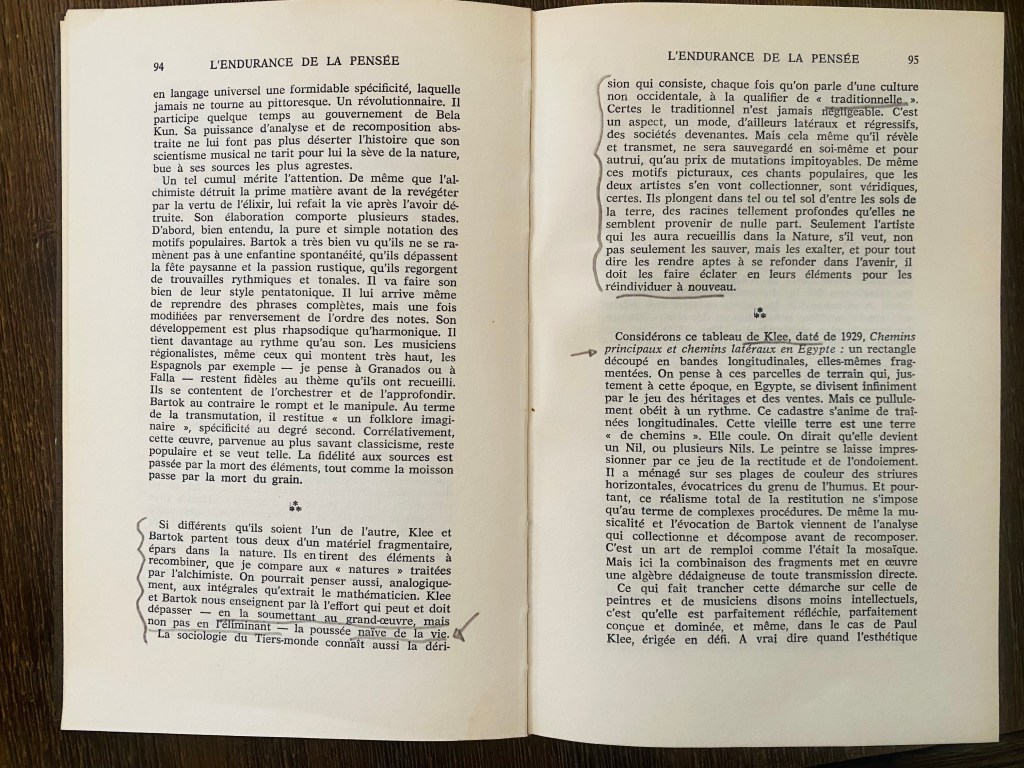
“La fidélité aux sources est passée par la mort des éléments comme la moisson passe par la mort du grain”.
07 Sunday Dec 2014
Posted in Paul Klee
Tags
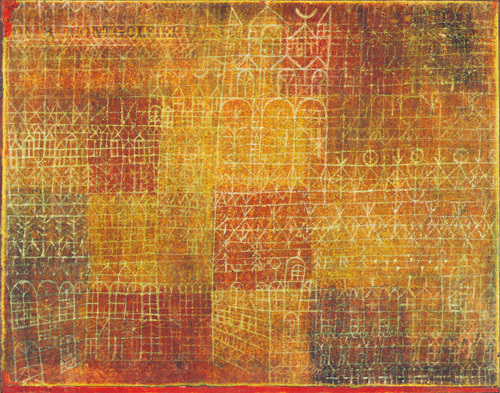
Klee, Paul. Cathedral. 1924, 138. Watercolor and oil washes on paper mounted
on cardboard and wood panel, 30.1 x 35.5 cm. The Phillips Collection,
Washington, D.C.
The Thinking Eye or any other book of Paul Klee, can not answer the question of what precisely the many symbols mean, but rather, they provoke the following issues: What essence is represented in this symbol? How did this sign come into being? What motivated its appearance? The responses to such a line of questioning shed a different perspective on his specialized interests.
The image of a fish provides examples. With fish in an aquarium, Klee might be representing the essence of space, for instance. In another picture, the image of a fish may have resulted from an exploration of organic structure. A fish could, in yet another painting, represent the idea of movement.
It seems obvious that the many recurring motifs and signs in Klee’s paintings do not constitute a cryptic message but are, in fact, representations of artistic investigation and truth.
The Thinking Eye is crucial to this type of understanding of Klee’s paintings, especially those completed during his tenure at the Bauhaus.
The Thinking Eye is useful for creating a condition of meaning and essence. The book do not offer direct answers about the meaning of Klee’s many symbols but rather provide a new, discursive way to explore them in his paintings of the Bauhaus years.
Anyone who really wants to provide a context for Klee’s production of his thinking eye and his symbol-dense paintings, the history of the Bauhaus needs to be considered.
The literature available on the Bauhaus itself and Klee’s affiliation with the school is extensive. To attempt to consult it all would not only be impractical but, more importantly, except for signaling out a few pertinent publications, a general survey of the literature would prove to be futile as it would detract from the investigation at hand. Instead, it is more prudent to weed through the literature, excise the irrelevant, and utilize only that which highlights the interchange between the philosophy and culture of the Bauhaus and Klee’s use of symbols.
How can the philosophy and culture of the Bauhaus be defined? A general history is needed but I will write another article about it. What we must keep in mind for now, is that the Bauhaus was founded by the architect Walter Gropius in 1919 and was dissolved by the pressures of the Nazi regime in 1933.
Cathedral painting example ( which for me, is really an Architectural Experiment) :
I am not going to delvin into the more complex architectural themes of Klee’s art, but just trace the formation of Klee’s ideas of architecture.
Early in his career, Klee displayed some interest in the subject of architecture, producing simple pen-and-ink drawings of familiar cityscapes. Soon he began to realize the potentiality of thinking architecturally.
During his year in Italy, Klee took special note of architecture and developed an interest in essentialized architectonic forms. Concentrating mostly on observed structural relationships, he wrote in his journal that, “now, my immediate and at the same time highest goal will be to bring architectonic and poetic painting into a fusion, or at least to establish a harmony between them.”
In a later diary he clarified the term “architectonic” and analyzed its effect on his development as an artist: « When I learned to understand the monuments of architecture in Italy, I won an immediate illumination. . . .Its spatial organism has been the most salutary school for me; I mean this in a purely formal sense. . .Because all the interrelations between their individual design elements are obviously calculable, works of architecture provide faster training for the stupid novice than pictures or
nature… Our initial perplexity before nature is explained by our seeing at first the small outer branches and not penetrating to the main branches or the truck. But once this is realized, one will perceive a repetition of the whole law even in the outermost leaf and turn it to good use. »
This new understanding of the formal relationships between parts and their whol allowed Klee to start exploring space in his art. It was not until after his trip to Tunisia, however, that these spatial concerns took on a truly architectural character. After returning from his sojourn on the northern African coast, where he began the synthesis of urban architecture and pictorial architecture,
Architectural thinking, in combination with architectural subjects, begins to appear more and more readily in Klee’s paintings. This new-found fascination with a new form of art can be seen in Klee’s adoption of architecture as a literal subject for his art.
However, it is Klee’s 1924 work Cathedral in combination with a close examination of Klee’s the thinking eye– that provides an bexemplary paradigm for exploring Klee’s inordinately close relationship to modern architecture and its concerns. As the title suggests, the watercolor and oil wash painting depicts a cathedral.
One can pick out a gallery with arches, a bay, vaulted ceilings, windows, and roof; all created with thin, light lines. Both the interior and exterior of the cathedral are shown concurrently. Visible are a tower and its roof, while (as if acting on the principles of transparency and temporality articulated by Giedion), the interior coloristic effects of stained-glass windows also present themselves at will. As the glass of the Dessau Bauhaus permits an interpenetration of the interior and the exterior, so too does Klee present his spectator with a conflation of time and space.
A certain affinity exists between Klee’s, Gropius’s and Giedeon’s thinking. Support for this can be found in Klee’s teachings, where he expresses, as Giedion did in Space, Time and Architecture, the need to move beyond central perspective: “It is only recently that we have been free to deviate from the rules [of perspective]. What do we gain by it? We gain the possibilities of spatio-plastic representation and movement that were limited under earlier methods.”
Klee is thinking in the same historical-minded way typical of Giedion, realizing how the more recent artistic experiments of the cubists and futurists have allowed the artist/architect to move beyond perspective and begin probing the relationships between time and space.
Furthermore, the “phenomenal transparency” called for by Rowe and Slutzky is also at work in Klee’s painting.
In Cathedral, the brightness and thickness of the lace-like lines vacillates ever so subtly between the forefront and the background of the picture plane. The bolder, brighter lines appear to be closer to the front while the lighter, duller lines to be farther towards the back of the pictorial space. Yet the density of each line does not remain the same.
For example, in one area of the painting a line may be bold but as it moves through the pictorial space it becomes duller and thinner.
It is impossible to decipher which line or form is closer and which is farther. The space is further complicated within the bottom left-hand corner where Klee utilizes orthogonal perspective.
Whereas the rest of the piece could be interpreted as flat (and almost purely decorative) the perspectival rendering of space forces the viewer to question the pictorial determinants of spatial arrangement to be able to decipher what precisely belongs to the foreground and what is part of the background. Without the emphasis on perspective, it would be easy to assume that the color wash comprises the ground upon which the lines lie. Yet as a copper patch of color advances, the wash becomes part of the foreground.
Foreground and background become interchangeable, if not abandoned altogether. Either way, there is a definite shifting in space throughout the work. With Cathedral, Klee presents the “simultaneous perception of different spatial locations” necessary for “phenomenal transparency” by playing with the viewer’s perception of the pictorial space.
In the consideration of Rowe and Slutzky’s paradigm (references to study for who wants to know more) , Klee would appear to move beyond the “literal transparency” of Giedion and enter the field of “phenomenal transparency” as the painting Cathedral clearly demonstrates. The vagueness of the term “phenomenal transparency” however, raises other concerns that resonate in Klee’s painting. Rowe and Slutzky never offer a precise definition of their term “phenomenal transparency.”
The closest they come to providing an explanation is in the second part of their discourse where they explain that “phenomenal transparency might be perceived when one plane is seen at no great distance behind another and tying in the same visual direction of the first.”
This insistence on planes is emphasized with their discussions of buildings designed by Le Corbusier in particular, specifically his villa at Garches. Le Corbusier accomplishes Képes’s goal of interpenetration “without optical destruction” through the play of glass and concrete planes. Between the parallel planar surfaces a tension is created that implies interpenetration without the translucent effects of the glass curtain of the Dessau Bauhaus.
If planes are required for “phenomenal transparency,” then the “phenomenal transparency” of Cathedral must be called into question. There are no parallel planes to be found in the painting that would correspond to this critical structural emphasis in Le Corbusier’s building. Instead, the way in which Klee conceives of planes can be surmised in his teachings.
For the artist, planes are formed through the tension between passive lines. As discussed previously, the lines in Cathedral are, by contrast, in a subtle, but constant motion; they shift through the pictorial space and cannot, as a result, constitute planes.
The planes that can be found in Cathedral are neither parallel to each other nor to the picture plane; they are arranged perspectivally. Here Klee’s pedagogy is highly instructive. The articulation of “perspective horizontal planes” and “perspective vertical planes” in The Thinking Eye describes specific configurations of shapes found in several places in the painting.
Although it might be possible to argue that these “planes in perspective” are parallel to one another (after all, they occur in bands), nonetheless the “planes in perspective” are formed by lines that seem to connect to one another, making it impossible to tell where one plane ends and the next begins. As a result, one cannot decipher which planes are “perspective horizontal planes” and which are “perspective vertical planes”.
Therefore, one cannot determine whether the planes are parallel to one another. Certainly, planes are depicted in Cathedral, but by looking at these forms in combination with Klee’s pedagogy, it becomes clear that they function in a very different way than they do in Le Corbusier’s buildings.
The question then arises: Does Cathedral work within the “phenomenal transparency” paradigm described by Rowe and Slutzky?
The word “phenomenal” implies something that is known through the senses; it comes from a Greek word phainesthai meaning “to appear”. From simply looking at Cathedral, Klee comes to reveal his phenomenal world: the image is imbued with the sensual effects of being in a cathedral. Arch and window shapes consume the picture; lines weave and overlap as do the many delicate features of a Gothic cathedral; a restrained luminosity recalls the effects of stained glass windows. Notwithstanding this reading, Klee rejects the fascination with the phenomenal. As shown by his lectures, appearance is merely a consequence of creation, not the goal. Form as phenomenon is a dangerous chimera. Form as movement, as an action, is a good thing, active form is good. Form as rest, as end, is bad. Passive, finished form is bad. Formation is good. Form is bad; form is the end, death.
Formation is movement, act. Formation is life. . .and the sections must fall into a definite structure; with all their widening development, one must be able to encompass them at a singe glance.
It seems then that Klee, by the example of Cathedral, rejects the pervading notions of spatial conception that concerned modern architects of his era. Instead of an interest in the “literal transparency” of Giedion or the “phenomenal transparency” of Rowe and Slutzky, Klee is concerned with spiritual (and not material) transparency. “Spirit” at its root means “breath” and implies a certain ineffable immateriality. Klee’s sketch of “the three dimensions combined in cube” bears a striking resemblance to line configurations found in Cathedral.
That the cube itself is omitted in the space renderings in Cathedral implies the immaterial nature of the work; never is the viewer presented with the appearance of a structure (the phenomenal) but rather the fundamental essence of a structure (the spiritual).
Klee worked in the spiritual realm through an exploration of the dynamic element. A concern with dynamism certainly occupied modern architects; the need for shifting perspectives and other movements in space has already been discussed in some depth. However, such architectural thinking failed to enter into the spiritual realm, which was an equally viable quest in modern art, and therefore modern architects could not reach their goals: “Pure dynamic action within a limited sphere is only possible on the spiritual plane.
To go even further, it may be that Klee is rejecting architecture altogether, or at least he
seems to be responding directly to the Bauhaus’s elevation of architecture as the ultimate goal of artistic training. He states: « Our means of investigating natural structures by means of cross-sections and longitudinal sections is no doubt applicable to architectural structures, but we should never find an example in which ground-plan and elevation were not undamentally different. Which again means that there is no example of the purely dynamic in this field. Consequently we must situate architectural works in the purely static sphere, though there may be a certain inclination towards the dynamic. . .in the more ideal realms of art, such as painting, the greatest mobility of all is possible, an actual development from the static to the dynamic. »
It is impossible to know if Klee is truly rejecting the supremacy of architecture at the Bauhaus; in the end, Klee’s personal attitude toward this hierarchy is of little consequence. What remains important, however, is the re-thinking of space and the artist’s engagement with spatial experiments. Through the examination of Sigfried Giedion’s Space, Time and Architecture and Colin Rowe’s and Robert Slutzky’s essays on “phenomenal transparency,” one discovers that alongside Klee’s works such as Cathedral and others point much more clearly to Klee’s investigation of space in architectural terms.
At the very least, we can begin to recognize that Klee was working with the very same spatial goals as modern practicing architects and contemporary architectural theorists. What follows then is an exploration of Klee’s use of certain symbols in his paintings that constitute a kind of architectural experiment.
I myself still wonder why we don’t teach Klee in Architecture schools.
 Selbstwehr
You must be logged in to post a comment.