1000 feet :
3000 feet :


Family :

26 Friday May 2017
Posted in Aviation, Uncategorized
1000 feet :
3000 feet :
Family :
15 Monday May 2017
Tags
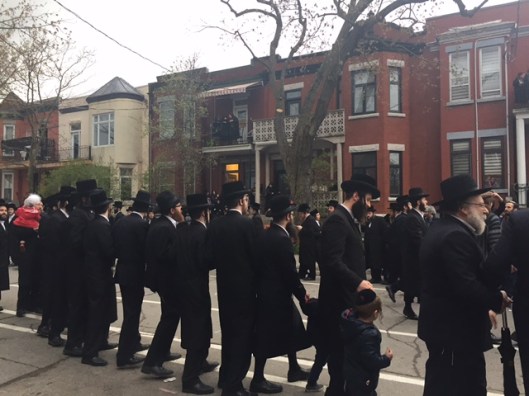


There is a custom to light bonfires in honor of Rashbi. The souls of all the tzadikim are there when the fire is lit. There is a custom to put olive oil in the fire and to burn clothes in the fire. The Rizhiner used to send silk garments to Miron to be burnt in the bonfire. Tzadikim of Eretz Yisroel say this is a segula for success, materially and spiritually.
Posted by S/O | Filed under Uncategorized
06 Saturday May 2017
Posted in Uncategorized
When I think about myself,
I almost laugh myself to death,
My life has been one great big joke,
A dance that’s walked
A song that’s spoke,
I laugh so hard I almost choke
When I think about myself.
Sixty years in these folks’ world
The child I works for calls me girl
I say “Yes ma’am” for working’s sake.
Too proud to bend
Too poor to break,
I laugh until my stomach ache,
When I think about myself.
My folks can make me split my side,
I laughed so hard I nearly died,
The tales they tell, sound just like lying,
They grow the fruit,
But eat the rind,
I laugh until I start to crying,
When I think about my folks.
18 Saturday Feb 2017
Posted in Uncategorized


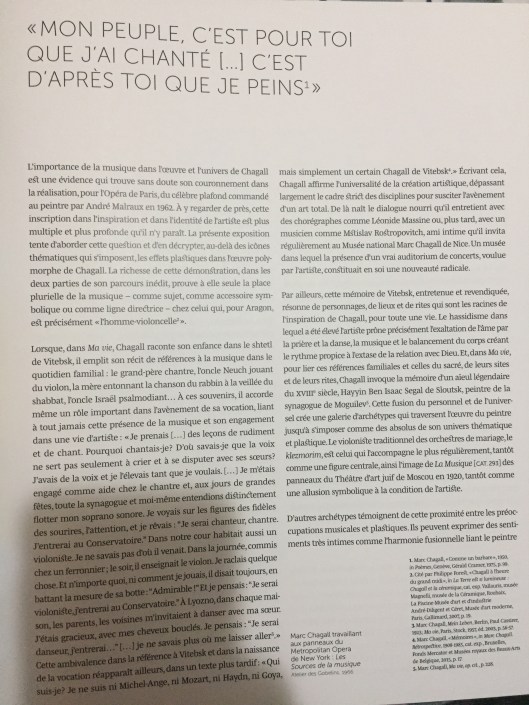


Music in the video :
31 Tuesday Jan 2017
Posted in Uncategorized
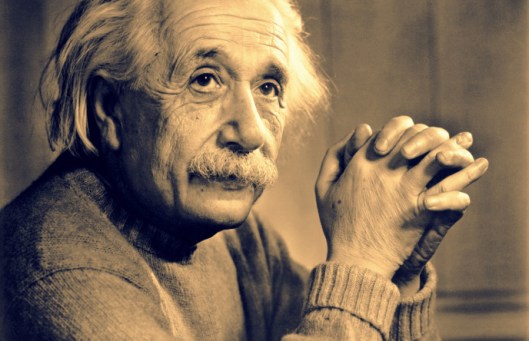
“Einstein immigrated to the United States in 1933, where he held a professorship at Princeton University until his retirement in 1945. His routine there was simple. Between 9:00 and 10:00 A.M. he ate breakfast and perused the daily papers. At about 10:30 he left for his Princeton office, walking when the weather was nice; otherwise, a station wagon from the university would pick him up. He worked until 1:00, then returned home for a 1:30 lunch, a nap, and a cup of tea. The rest of the afternoon was spent at home, continuing his work, seeing visitors, and dealing with the correspondence that his secretary had sorted earlier in the day. Supper was at 6:30, followed by more work and more letters.
Despite his humble lifestyle, Einstein was a celebrity in Princeton, famous not only for his scientific accomplishments but also for his absentmindedness and disheveled appearance. (Einstein wore his hair long to avoid visits to the barber and eschewed socks and suspenders, which he considered unnecessary.) Walking to and from work, he was often waylaid by locals who wanted to meet the great physicist. A colleague remembered, ‘Einstein would pose with the waylayer’s wife, children, or grandchildren as desired and exchange a few good-humored words.
Then he would go on, shaking his head, saying: ‘Well, the old elephant has gone through his tricks again.’ ”
__________
The section on Albert Einstein in Mason Currey’s book Daily Rituals: How Artists Work.
26 Thursday Jan 2017
Tags
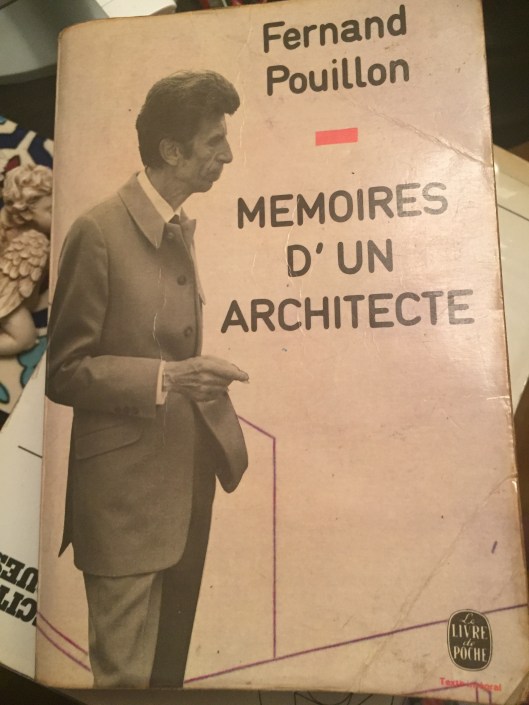
”Depuis cent ans, le monde des bâtisseurs joue les apprentis sorciers avec la vie des hommes. L’art, l’architecture notamment, évolue dans un sens de plus en plus ésotérique. Graphisme et photographie ont fait basculer les maisons et les monuments dans un univers d’abstraction.
la représentation prend des libertés avec la réalité ou la moque. Les génies de notre époque s’attachent trop à ce qu’ils jugent “publiables”, photogénique.”
Fernand Pouillon


Posted by S/O | Filed under Architecture, Uncategorized
26 Thursday Jan 2017
Posted in Uncategorized
Tags
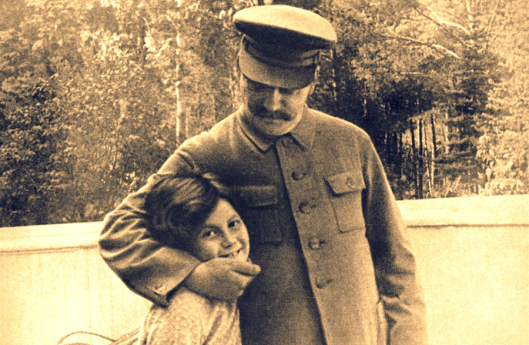
“Stalin really hated him. It took me several days of subliminal work to accept this. The standard interpretation may seem ridiculous, but it is probably the right interpretation. We have seen something of Stalin’s violent insecurity about his provenance. This insecurity was now turned on Yakov. Stalin hated Yakov because Yakov was Georgian. Yakov was Georgian because his mother was Georgian; Yakov was Georgian because Stalin was Georgian; yet Stalin hated Yakov because Yakov was Georgian. The racial and regional tensions within the USSR constitute an enormous subject, but Stalin’s case was, as usual, outlandish. We have to imagine a primitive provincial who (by 1939 or so) had started to think of himself as a self-made Peter the Great: an Ivan the Terrible who had got where he was on merit. Thus Stalin was Russia personified; and Yakov was Georgian. Yakov is said also to have been of a mild and gentle disposition, to his father’s additional disgust.
Raised by his maternal grandparents, Yakov joined the Stalin household in the mid-1920s. He spoke little Russian, and did so with a thick accent (like Stalin). Nadezhda seems to have liked him and fully accepted him. But Stalin’s persecution was so systematic that toward the end of the decade Yakov attempted suicide. He succeeded only in wounding himself; and when Stalin heard about the attempt he said, ‘Ha! He couldn’t even shoot straight” (Volkogonov has him actually confronting his son with the greeting, ‘Ha! You missed!’) Soon afterward Yakov moved to Leningrad to live with Nadezhda’s family, the Alliluyevs.
Like Vasily, Yakov joined the armed forces, as a lieutenant (rather than a field marshal), reflecting his more peripheral status. He was the better soldier, and fought energetically until his unit was captured by the Reichswehr. This placed Stalin in a doubly embarrassing position. A law of August 1941 had declared that all captured officers were ‘malicious traitors’ whose families were ‘subject to arrest.’ Thus Yakov came under the first category – and Stalin came under the second. As a kind of compromise, Stalin arrested Yakov’s wife. When the Nazis tried to negotiate an exchange, Stalin refused (‘I have no son called Yakov’). He feared all the same that the supposedly feeble Yakov might be pressured into some propagandist exhibition of disloyalty. He need not have so feared. Yakov passed through three concentration camps – Hammelburg, Lubeck, Sachsenhausen – and resisted all intimidation. It was precisely to avoid succumbing (Volkogonov believes) that Yakov made his decisive move. In a German camp, as in a Russian, the surest route to suicide was a run at the barbed wire. Yakov ran. The guard did not miss.”

__________

17 Tuesday Jan 2017
Posted in Uncategorized
Tags
15 Sunday Jan 2017
Posted in Uncategorized
There have been “real ehrlicher Yidden” who listened to classical, folk, and other secular music forms. Or read secular poetry.
With all due respect, our medieval paytanim were awesome tzaddikim, but they were not as great writers as William Blake or Dylan Thomas or Robert Frost, and not too many frum instrumentalists compare to Leo Kottke or John Coltrane or Andres Segovia or Pablo Casals…
Says Rav Kook [Mishnato shel HaRav Kook]:
“It is a mean eye that causes one to see only ugliness and impurity in everything beyond the bounds of Israel, the unique nation. This is one of the most awful, debased forms of darkness. It damages the entire edifice of spiritual virtue, the light of which every spiritual soul seeks.”
Rav Hirsch was a big fan of the poetry of Schiller. His famous speech about the romantic poet Schiller, until now has not been translated into any language from its original German. The reason is that Hirsch’s attachment to Schiller has not been shared by more recent generations.
Here you can read pdf it and finally understand why R.Hirsch was so attached to German culture and how he could find such spiritual value in writings outside the canon of Torah literature.
11 Wednesday Jan 2017
Posted in Uncategorized
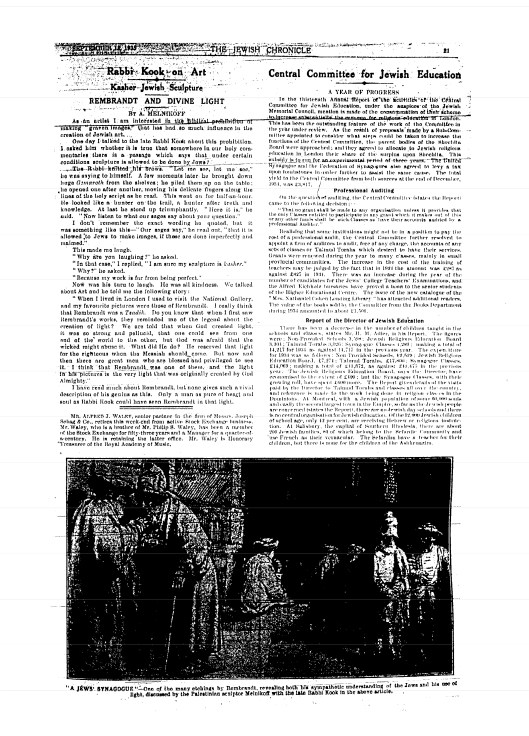 Jewish Chronicle article pdf by Avram Melnikoff (1892-1960), a sculptor from Jerusalem who lived in London from 1933-1959. The article was written two weeks after Rav Kook’s passing and the author recounts a conversation that he had with Rav Kook, where the latter told Melnikoff:
“When I lived in London I used to visit the National Gallery, and my favourite pictures were those of Rembrandt. I really think that Rembrandt was a Tzadik. Do you know that when I first saw Rembrandt’s works, they reminded me of the legend about the creation of light? We are told that when God created light, it was so strong and pellucid, that one could see from one and of the world to the other, but God was afraid that the wicked might abuse it. What did He do? He reserved that light for the righteous when the Messiah should come. But now and then there are great men who are blessed and privilaged to see it. I think that Rembrandt was one of them, and the light in his pictures is the very light that was originally created by God Almighty.”
Melnikoff concludes that he had “read much about Rembrandt, but none gives such a vivid description of his genius… Only a man as pure of heart and soul as Rabbi Kook could have seen Rembrandt in that light.”
Sources: London Jewish Chronicle, September 13, 1935, p. 21.
 Selbstwehr
You must be logged in to post a comment.