The Gemara says that a person should say to himself, “The whole world was created only for my sake.” This thought has far reaching implications. When you realize that the whole world was created for no one but you, it follows that you are the only person in the entire world, and that the survival or destruction of the world hinges on your choice to do good or evil. Since you are the only one around, you need not be concerned about the opinions of others when you are serving G-d, for next to you, all else is of secondary importance. When you look at life from this perspective then you will serve G-d with total devotion, without any ulterior motive or muddled thinking. You will then break down all the klippos – the outer barriers that prevent you from perceiving holiness.
From his window facing the marketplace Rebbe Nachman spotted one of his followers rushing by.
“Have you looked up at the sky this morning?” the Rebbe asked.
“No, Rebbe, I haven’t had the time.”
“Believe me, in fifty years everything you see here today will be gone. There will be another fair–with other horses, other wagons, different people. I won’t be here then and neither will you. So what’s so important that you don’t have time to look at the sky?!”
Rebbe Nachman of Breslev states that it is a segulah to gaze at the sky. (A segulah is something that has some sort of mysterious power, although we may not understand how it works.) He does not exactly say what this is a segulah for, but it seems to be for wisdom.
Today i sat looking at the sky. The blue expanse was especially clear and luminous, and it occurred to me that thoughts are like clouds, massing in the open space of the mind, even taking over, magnetizing all of our attention, but still constantly changing, rearranging like the glass fragments of a kaleidoscope. Yet the open expanse remains the same. Spiritual obstacles are also like clouds. Rebbe Nachman states that all obstacles are illusory, but the main obstacles are those of the mind. They may seem to be the most insubstantial, but not when a person stares them in the face.
Nachman suggests that the essence of reality is actually the “World of Thought” : the cosmic mind. Everything comes from there, and returns there, and in truth — although this is hard for us to grasp — everything constantly remains there. We experience a physical universe, but it emerges from the divine thought:Thus, all existence is like the clouds. Each created thing appears to be solid and firm, but in truth it is insubstantial and transitory. As we say on Rosh Hashanah at the end of U’nesaneh Tokef, “Like a broken shard, like withering grass, like a fading flower, like a passing shadow, like a dissipating cloud, like a gust of wind, like a swirl of dust, like a fleeting dream…”
” When things are very bad, nullify yourself completely. Close your mouth and close your eyes – this is nullification”. Rebbe Nachman.
“When the upper and lower waters were separated from each other, the lower waters were promised that they would also have a chance at elevation. They would be offered on the altar as salt, as well as during the water-libation of Sukkot. Both opportunities had to be promised to the lower waters to mollify them.”
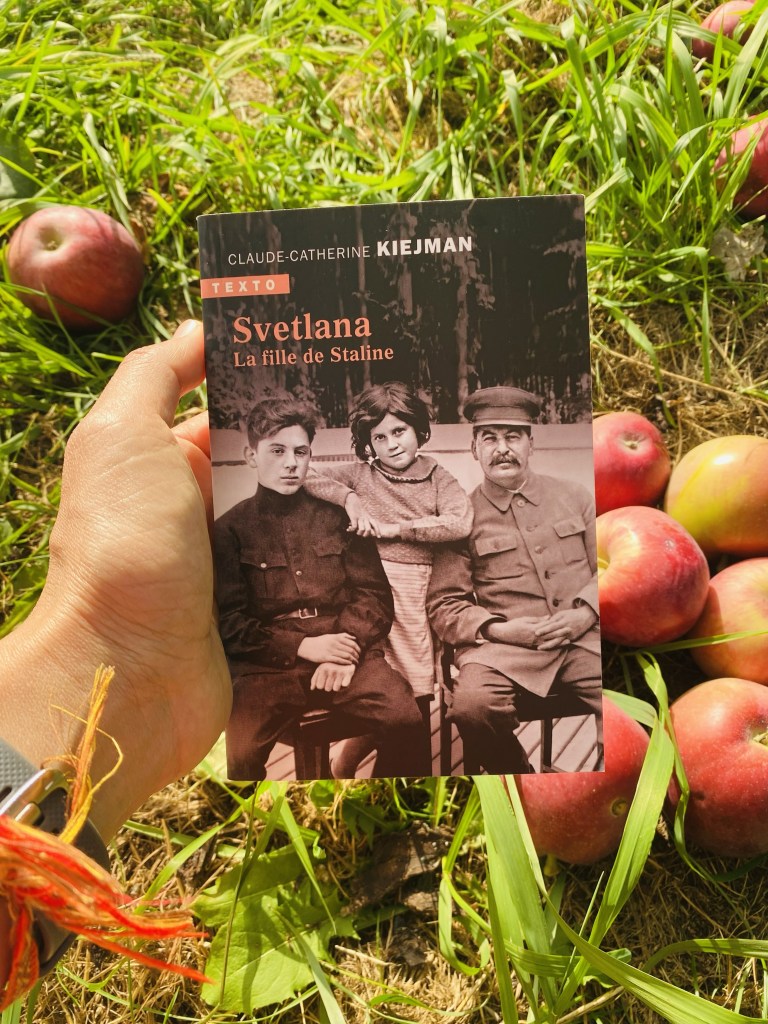
The fragments of information that emerged from the book ( so far ) suggests that Svetlana life had become lonely and unpleasant. In 1985, Time published a story in which she was described as isolated, overweight, vindictive, imperious, and violent. “Her ultimate quarrel was with her father, whom she fatefully resembled”… nothing more awful than resembling to the monster she hated all her life.



 Selbstwehr
You must be logged in to post a comment.