• About

Selbstwehr

~ Art as self defense

Category Archives: Uncategorized

Desire

20 Friday Feb 2015

Posted by S/O in Uncategorized

≈ Leave a comment

Desire is like constructivism in architecture:

We never desire something or someone out of a context, we never desire it as an isolated entity even if we want to believe that we really do.
We always desire in a set of data, in a landscape. That’s why Proust said: “I do not desire the woman but the landscape wrapped in that woman”. Obviously we can only sense it and its interpretation depends on our own redundancy and our own tree structure.

Find out the relationship between the different elements that constitute the whole imagery is the key to understand the construction of desire. That’s why I’ve always said that the heart does not have any arithmetic but only geography.

Share this:

  • Share on X (Opens in new window) X
  • Share on Facebook (Opens in new window) Facebook
Like Loading...

Beethoven’s “Muss es sein?”

12 Thursday Feb 2015

Posted by S/O in Uncategorized

≈ Leave a comment

Tags

Beethoven, Muss es sein

1512361_10152655051091011_7467025476769022016_n

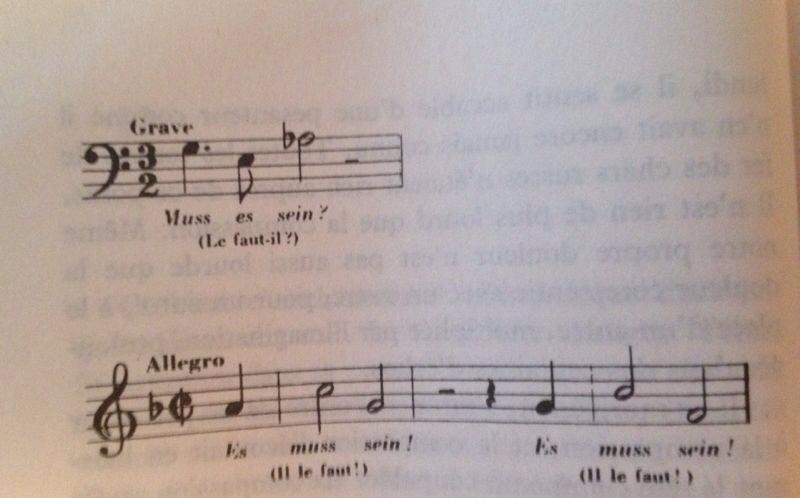
Beethoven’s last completed work before his death was the Opus 135 String Quartet whose last movement is entitled: “Der schwer gefasste Entschluss” meaning “The Resolution hard to take” or “The Difficult Decision.” Three ominous notes open the movement and were marked: “Muss es sein?” (“Must it be?”…A very definite fear and anxiety is expressed by this motif which is then replaced by an upbeat reply designated: “Es muss sein! Es muss sein!” (“It must be! It must be!”)… Many believe that what Beethoven was trying to convey was the feeling of being before the Great Eternal, the Awesome specter of God … We are uncertain and cowered by it, but when we see the Truth we embrace and rush towards it…. Personally I think that Everything that occurs out of necessity, everything expected, repeated day in and day out, is mute. Only chance can speak to us…This is an important line. What happens by fate = what happens by necessity = what is repeated = that which belongs to the realm of eternal return. What happens by chance = the fortuitous = what happens only once. And what happens only once, by chance, can have meaning, too…

It’s a complicate lightness/weight dichotomy….because it argues that what happens only once can have meaning…

Share this:

  • Share on X (Opens in new window) X
  • Share on Facebook (Opens in new window) Facebook
Like Loading...

WORDS 6

22 Thursday Jan 2015

Posted by S/O in Uncategorized

≈ Leave a comment

To choose a sexual partner today is to choose a surface of redundancy that says: do you recognize me when I talk to you?

This redundancy of the me = me is a black whole which is nothing other than a star that captures  and emits no light.

Share this:

  • Share on X (Opens in new window) X
  • Share on Facebook (Opens in new window) Facebook
Like Loading...

Momentum anti-cloning of the tree of knowledge, materialist historians and conspiracy narrators

13 Tuesday Jan 2015

Posted by S/O in Uncategorized

≈ Leave a comment

10915172_1530732063852926_6626668655529806588_n

Words on the screen like locust swarm are subject to what Walter Benjamin called “the vertical dictatorial ” … which excludes any form of meditative reading.

Literature, media and writing are degraded, serialized to a form of ideologies for the new “intellectuals” and loafers. He said about Baudelaire, the lethargic witness of the defeat of the labor movement in June 1845, which, as Marx said, was the most colossal event in the history of the European civil wars, which subsequently served as a fertilizer for the emergence of two totalitarian regimes in Europe (national socialist and communism), that he suffered a double dichotomy: he had an ear for the songs of the revolution but also an ear for the drum rolls of executions.  Because in the large field of the information and general demands, fine literature asserts itself only as a serial, due to the pervasive corruption of the media.

The loafers  shall be supplied with sensations, seller with customers and the little man with images from the world. Today we need to be aware of false consciousness and its utter uselessness in public discourse.

The historically effective writer or journalist has left the stage of history. Secondary orality has become the only medium between people and generates the loss of the correlative importance, makes us pick unripe fruit of the tree of knowledge and the general informational and social chaos.

S.M

Share this:

  • Share on X (Opens in new window) X
  • Share on Facebook (Opens in new window) Facebook
Like Loading...

Schopenhauer and Buddhism

30 Tuesday Dec 2014

Posted by S/O in Uncategorized

≈ Leave a comment

Tags

Schopenhauer

There are notable similarities between the philosophy of Arthur Schopenhauer (in its three dimensions, metaphysics, aesthetics, ethics ) and the Indian Buddhist and Brahman doctrines that no one can deny.
Schopenhauer himself recognized it in his work. However these affinities hide important differences. It’s very important to keep in mind that Schopenhauer philosophy and the Indian thought are asymmetric. There is, in first hand, a one-dimensional philosopher of the nineteenth century with a precise idea of his philosophy, and in the other hand, a huge multidimensional ancient civilization, rich with diverse philosophical and religious doctrines.

In the intellectual legacy of Schopenhauer, he was mostly influenced by Plato and Kant, as he says himself. The impact of reading the pietistic Matthias Claudius (at the age of 18 years) was also decisive. And we must add the inspiration received by the great mystics and Western moralists.

Schopenhauer is full of sympathy and admiration for philosophers and religions of India, he was considered as the first Indo-European philosopher of history: “I don’t think, I admit, that my doctrine could have been before the Upanishads, Plato and Kant were able to throw together their shelves in the mind of a man.”

The truth is that it’s for the confirmation and justification of his own theses that Schopenhauer refers to Indian data. India was for him a true “mirror” in which he sees the reflect of his own thinking and the philosopher finds the great superiority of Buddhism and puts it above all the other religions.

Proclaiming the affinity of Buddhism with his doctrine, the philosopher wrote these lines: “This similitude is much more enjoyable to me, as my philosophical thought was certainly free from Buddhist influence because until 1818, during the publication of my book, we only had in Europe rare publications about Buddhism, they were confined almost entirely to a few essays, published in the first volume of “Asiatic researches” and relating mainly to Brahmanism and Buddhism”.

So let’s start with the great thesis of Schopenhauer: “The will is affirmed, then denies” the affirmation and negation of the will to live are simple and velle nolle. The subject of these two acts is one and the same and therefore will be not destroyed by either the one or the other”.

If the first is the will to live, the second will be the phenomenon of the will not to live. This diagram shows many similarities with Sanskrit texts : desire / no desire, activity / inactivity, engagement / renunciation experience / enjoyment of the world, withdrawal / rejection of the world.

Schopenhauer put them in touch with the world of transmigration and extinction / liberation (Nirvana).

So what did he mean by “ the will” ?

In the philosophical system of Arthur Schopenhauer, there is no clear distinction between “will” and “will to live”. We must not understand it as a faculty to be able to do or not something or the “intention to do something,” but: it is all about foolish desire, a blind and irresistible desire, as the one we see in the vegetable life, and their laws, as well as in the vegetative part of our own body, it’s “somehow synonymous with the pulse energy or the original power.”

The phrase “will to live”, following those remarks, did not make much sense. “Will” simply to express the will to live.

This notion has affinities with the concepts of Brahman in Upanishad, which refers to the one and all, the universal self, precisely the periodic creation of the universe.

But why we must deny the will to live?

To achieve the mental state where a man needs to deny the will, he must have understood how life is only suffering, and above all he must have felt it. Man must see “the terrible side of life, pain nameless anxieties of humanity, triumph over the wicked, the irretrievable defeat of the innocent”.

The pain is manifested in two ways in the life of a man: first in the constant desire and in the constant struggle. He must accept the true death.
“The will, at all levels of its manifestation, has no final end and is incapable of a final satisfaction. “

This idea has similarities with the Indian concepts of desire (kama) in all its forms, with the passionate attachment (raga) and thirst (trsna). This is according to the Buddhist texts, thirst of pleasure (kama-trsna).
These similarities are striking. Schopenhauer was studying the Indian link between desire (will to live) and suffering (duhkha). In concordance with the Buddhist texts he noted that suffering is the foundation of all life. (See the oath of Benares-everything is pain).

Man can’t stop his desire and therefore he will be the slave of the Will, the suffering will be linked to it. If ever a desire is satisfied (note that a desire can’t be fulfilled, but in the best of cases satisfied), satisfaction is only to avoid suffering and not a positive granted happiness . This idea shows what vision of life Schopenhauer had: man suffers and if he reaches a desired object, it is only to suffer less and not to be happy. It’s a different state of mind of one who would take as truth: the man is happy and satisfies a desire, it boosts happiness.

Schopenhauer was truly a pessimist, a pessimist man can only survive, optimistic man lives. Once a satisfied desire (which is hard and as we said before serves only for the appeasement of suffering), man may miss new objects to be desired which will bring him boredom. This lack of object to be desired is because the Will itself lacks object to be desired and this puts people in a “terrible void.” However, man has found a way to not get bored, and hide “the emptiness and banality of existence”: his mind superstitions are created by an imaginary world. These creations of the mind are made by the people for whom life is easy (“with a mild climate and soil,” says Schopenhauer): Hindus, Greeks, Romans … The imaginary world which Schopenhauer speaks is a world in which man manufactures likeness of demons, gods, saints. He then made sacrifices, prayers and other rituals. This imaginary world and the actions that follow are “the effect and symptom of the dual need of man, the need of help and assistance to shorten the time.”

Schopenhauer notes that “all the various forms of nature and life forms dispute the matter.” To live, we must make efforts and the idea of effort for him is the very idea of the will. We must continually fight against the interminable obstacles (otherwise there would be no struggle) and therefore continuously suffering. Schopenhauer says admirably: “With every sip of air that we reject, it’s death that would penetrate us, and we hunt; so we deliver a new battle every second, and even though at longer intervals, when we take a meal, when we sleep.., etc. Finally death will have to triumph; because it is enough to be born to befall sharing; and if for a while death plays with her prey, she is waiting to devour us. When you blow a bubble, you put take the time to take care of it, to appreciate it; but it will burst away, we all known that ».
This passage shows us two things: man must fight and his life is about survival (Every second he must fight until death, one can’t reasonably talk about life). The metaphor of the bubble is that Schopenhauer put the human adult as child. Indeed, it is mainly the children who play blowing bubbles. This is a naive and childish behavior: focusing on one thing as quickly perishable as a bubble. However, this behavior certainly is touching the bottom. The life that we have, ultimately do not belong to us (since it is about the Will), which is similar to billions of other lives and therefore not worth more and, at the scale of infinite existence of the will, as it does not represent anything.

To understand the philosophy of Arthur Schopenhauer, the reader should really be concerned with what is said, the pain must be felt. Otherwise we will find absurd Schopenhauer’s philosophy, we must first admit that suffering is our world . Schopenhauer was a philosopher who lives what he writes, he has such great contempt for optimism: “I can’t conceal my opinion here; is that optimism, when it is not a pure meaningless verbiage, as happens in these flat heads, where all guests staying in words, is worse than absurd way of thinking; it’s a really infamous opinion, hateful mockery, facing unspeakable pain of humanity”.

But then what is the purpose of the negation of the will and its relation to the Hindu Maya?
Maya is the veil of illusion that covers the eyes of the mortals, makes them see a world where we can’t say if it’s real like the sunlight on the sand.

And issuanceamong the Buddhistsis the supremegoal(parama-purusartha). Schopenhaueralsois seeking for anultimate goalbut it’s not the samething as his philosophyends withthe nonsense, theabsurdand it is verydifficult to find aphilosophy ofabsurd ortragicin the Indian context.

The Hindutheory of the fourhumangoals (purusartha) is the way for a Buddhistsalvation, while for Schopenhauer,to denythe willis not so muchto stopsuffering but the absolutecessationof desire.

Desire iswhat ailsthe man. By denyingthe Will, which createsour desire, we end it.

The philosophy of Schopenhauer is not a depressive philosophy in a state of passivity. What he proposes is a real fight, surely the most difficult because it is a fight against ourselves .

.
But there is a big difference between the bright and peaceful lucidity of Buddha and the bitter and morbid lucidity of Schopenhauer. Buddha wants the liberation of man by the(marga) way which takes into account the human initiative (purusakara) in the large circular and cyclical time and (kalpa yuga ) where everyone has the opportunity to improve his future and the qualities of his future births depends on what we do now.

Schopenhauer is a pessimist, he hates crowds, he does not mix with the herd, he thinks the world as will and for him no genius can’t be sociable.

While most philosophers fight the divine idea of god, Schopenhauer believed that religions are necessary for people, but as he says himself: “Ask a Goethe or a Shakespeare to accept dogmas is like asking a giant to wear shoes of a dwarf. “

For Schopenhauer, if we did not have to die we would not be religious except for Buddhism, which is a religion without God and aspires to a real death by interrupts the cycle of rebirth. His central thesis is that death is an illusion, the lives of parents is the same life of children. That’s why he gave all his dogs the same name.
The fear of death is unknown for him, his biggest problem is precisely that death does not kill in the substance that is the world as Will, when a body decomposes, its elements make up a new one, Death does not kill because it is not beyond the world. Human existence persists in its lust.

In Buddhism, death (mrtyu) is not equivalent to the issuance (moska) except in the case of the accomplished sage. But Schopenhauer seems to ignore the Buddhist notion of deliverance from the body (videhamukti). When the survival of the species is valued in the first part of the Veda, there even has rituals to ensure the continuity of generations as in periods of Upanishads and in the midst of ascetics: “We make seed, we who with the Atman, have the salvation? Give up search for a son to seek for a wealth … “.

Despite this position, Schopenhauer never had any intention of acting on the world or to improve the human condition, unlike Descartes, Nietzsche or Spinoza for example. For him, if the intelligible substance of the world is reducible to chance it makes the idea of a revolution contradictory and the world can’t be changed.

Schopenhauer deconstructs the Will and the illusion of freedom, He is also the thinker of selfishness, I would even say that there are no more selfish than him, he never made a generous act, he was a total asocial person. He even said once that sociability of someone is inversely proportional to his intellectual value.
Schopenhauer has a very little success in the universities; maybe his weakness comes from his break between the will to live and intelligence. Intelligence is entirely a matter of feelings for him, which explains the lack of debt he has obtained from the philosophers. But personally I think that thanks to him we escape the cult of reason since Plato has given utmost importance to intelligence But Schopenhauer gives more importance to instinct and desire, he takes the opposite path.

Actually the whole philosophy of Schopenhauer leads us to stop the will to live a bit like the Buddha.

Getting Back into Schopenhauer texts made me smile a lot, knowing that the essence of Judaism is the will of man. I wonder about the interest to write an article about Schopenhauer under the microscope of Judaism.

Share this:

  • Share on X (Opens in new window) X
  • Share on Facebook (Opens in new window) Facebook
Like Loading...

The memory of the furure can open

30 Tuesday Dec 2014

Posted by S/O in Uncategorized

≈ Leave a comment

10885501_819585404768486_932258040431310473_n

בראשית מט’

טז דָּן יָּדִין עַמּ ו כְּאַחַד שִבְּטֵי יִשְּרָּאֵל יז יְּהִי דָּן נָּחָּש עֲלֵי דֶרֶךְ שְּפִי פן עֲלֵי ארַח הַ נשֵךְ

עִקְּבֵי סוּס וַיִ פל רכְּב ו אָח ור

This Shabbat I stood for the mourner Kaddish and since that moment I keep trying to understand how difficult was the two last months. I started than thinking about this week Paracha (Vayé’hi- ויחי ) which literally means : and he lived. And I realized how powerful can be the answer when we know how to listen to our tradition.

Vayé’hi is the last Paracha of the sefer Berechit and the text is basically about the last days of Jacob’s life, his meeting with Joseph after many years of separation and his last benedictions before his death.

This Paracha has a particular typography, revealed first by Rachi. It’s what we call a Paracha Stouma (closed). Most of us know that the Parachiotes are usually structured by a white (space) commanded by the tradition. This white space separate each Paracha from the next one, but Vayé’hi has no white. It follows immediately the Paracha before.

We can say that the whites in the texts are times for breathing. A Paracha stouma is a Paracha where we don’t breathe and it’s exactly the first teaching of Rachi who says : « When Yacov passed away, the hearts and the eyes of the Bné Israel were closed by the suffering endured by the exile » and so was mine after his death.

Why the death of Yacov enclosed the hearts and the eyes of Israel ? Specially as we know that the exile started way before Yacov death, maybe from the birth of Yitshak. Of course, we can say symbolically that during the exile we can hardly breathe but I feel that it’s really not about that.

The Morning Prayer Chaharit is attributed to Avraham. The afternoon prayer is attributed to Itshak and the night prayer is attributed to Yacov and it’s very strange because this last one is not a required prayer. It’s the divré rouchout. Yacov is the divré rouchout.

The Hassidout says, : « as long as our interior moral balance stays the same , the circumstances don’t affect us ». But if you lose your interior balance, you will feel the weight of the circumstances. Exactly as Yacov death, exposed Israel to the exterior pressures. Exactly as I was so exposed to everything.

And I thought about the testimony of Etty Hillesum, this young Jewish Hungarian, dead in Auschwitz in 1943. «  I feel imbricate in life, it ‘s not me anymore who wants to do this or this but life is great, good, passionate, eternal, and if we give all the importance to oneself , agitate, and struggle, we miss its powerful current ». In her most unfavorable circumstances, she was able to feel this current of life inside of her. Passion and purpose and full-fledged living feel right to her. However passion and purpose are never tidy or tame, or perfect. They demand a bit of mess and wildness and surrender. They want our rushing river, our drive and our need. They want our aliveness. They don’t care about logic. They need our heartbeats.

Yacov when he gave the benedictions to his sons, he wanted to tell them the future, but god enclosed his eyes , so again we see the prophecy was taken away from him but when he gave benedictions to Dan, he compared him to a snake that slips the rider from his horse and Rachi says that this means that Yacov won back the prophecy and saw that Samson was captured and humiliated by the philistines.

When Yacov saw this prophecy , he asked god for hope, the hope is primordial in Judaism. The Tikva is exactly the conclusion of the sefer Berechit. And it’s about the memory, to remember that there is always a new door to open for breathing. The true memory serves to see the future as said Rabbi Nahman.

And I personally , adore those who have been through the adversity and heartache and obstacles as impossible and gigantic as he the sun itself. They usually make it with hearts as warm as gold. Lives burned with intention. Hope as deep as oceans, they know how to start again and how to walk through walls with palms wide open, and how to begin at the edge and end. Those to me are the best people. As said the Mexican proverb : “They tried to bury us, they didn’t know that we were seeds”.

I’ve learned through this experience that when there is a fresh wound in your heart keep it open until it heals. Air it out. Understand it. Dive into it. Be fierce enough to become it. If you ignore it, it won’t be able to breathe. If you ignore it, it will merely deepen, spread and resurface later.

And when later happens, it will hurt even more. Because when later happens you won’t know what you’re bleeding for.

I’ve learned to remain with it until it clears. And watch the beauty pour into my openness. I learned to remain open to feel lightness. Remain open to feel free.

Share this:

  • Share on X (Opens in new window) X
  • Share on Facebook (Opens in new window) Facebook
Like Loading...

Paul Klee Sea Level : The black and white Arrows

26 Wednesday Nov 2014

Posted by S/O in Uncategorized

≈ Leave a comment

possibilities-at-sea-browse-by-title-norton-simon-museum-1392951100_b

Title of the Painting : Klee, Paul. Possibilities at Sea. 1932, 26. Oil-color on stretched canvas, 97 x 95.5 cm.

To better understand the use of specific symbols in Paul Klee paintings. I am, as an Architect, particularly concerned with examining how the dialogue between Gropius’ principles – that a combination of fine arts and applied arts should be reached resulting in the final product of Architecture – inspired Klee to take a more architectural approach to painting.

As an artist working at the Bauhaus, Klee would not only be continually faced with modern architecture, but would be able to engage with the new concerns of spatial construction outlined in contemporary architectural experiments.

In the decade (1921-1931) that Paul Klee was a master-teacher at the German Bauhaus, he produced a series of paintings infused with a primordial aura and marked by an artistic topos: the arrow. The arrow usually has a recognizable function, but in Klee’s 1922 painting Good Place for Fish, the arrow is puzzling.

Several of Klee’s various arrows, some articulated in pen-thin lines, feathered like an arrow shot from a bow and others stouter and bolder, like the arrows of indication found in the urban environment, are placed in deep green and blue bands of color amongst several fish-like forms.

Thoughresembling attack arrows, the feathered arrows in Klee’s painting are not directed at the fish, but rather they are pointed downward and, because of the way their points and feathers align with the bands of color, they appear to be motionless, suspended in the watery ground. Likewise, the bolder arrows resist their typical role, one of a precisely comprehensible indication. Klee’s arrows are confusing: they show motion, indicate direction, and guide the viewer’s eye.

The arrow is but one symbol that is ubiquitously present in the Klee’s oeuvre.

In such an examination, Klee’s pedagogy naturally becomes a key concern. Not only does it provide the means through which to understand the artist’s development as a painter concerned with architectural concepts, but it serves as the apparatus for investigating the intractably enigmatic symbols that inhabit Klee’s paintings.

The arrow is a common, recognizable symbol that is frequently present in the paintings that Klee produced during his Bauhaus years (1921-1931). It figures prominently in, among other paintings, « Possibilities at Sea » (1932 Norton Simon Museum).

Moreover, the arrow is ubiquitous in Klee’s pedagogy as both a subject for elucidation and elucidating a didactic tool. It makes its first appearance in The Pedagogical Sketchbook as an activator and repeated throughout the pedagogical writings, the arrow acts as energy that activates elements in the diagram.

Klee explains the illustration as « passive lines which are the result of an activation of planes » (line progression).

Arrows are used to show this activation. They can be seen performing the same energy-infusing role in Klee’s paintings. Entering the painting from above as if it were a heavenly ray of energy, the massive black arrow in Affected Place appears to set in motion the miniature world beneath it . The forms below imply buildings, ships and even a little person (the summary legs and torso are evident though no head or arms are apparent) all slightly off-kilter to indicate activity.

Disguised as part of the micro-world, it points directly at the figure’s back as if transmitting the energy from its larger companion arrow. Energy can also be classified as “stress” in that it contains forces that oppose one another.

Indeed, in the summary of Klee’s exploration of basic forms, the stresses that generate the forms are indicated by arrows. The concentration of stress points and their directional arrangement as fixed by arrows is directly linked to the creation of rectilinear shapes. The arrow as activator is the representation of energy and also implies motion.

In Klee’s pedagogy the arrow is more often than not the indicator of direction. This jobis a matter of life and death with the spiral, for instance; if the arrow indicates the direction of movement as outwardly-directed, the spiral infers a living and growing process; if the arrow indicates the opposite direction, the spiral is shown to be expiring, waning in its ability to generate energy, and dying.

This display of extremes, the life-and-death role prescribed to the arrow is born out pictorially in Possibilities at Sea, and encaustic and sand painting that Klee completed in 1932 while teaching at the Düsseldorf Academy.

In this painting, a sailboat-like structure of red and white lines floats on water (indicated by elongated blue rectangles and a brown squiggle) between the sun and the moon. As implied by the title of the work, the sailboat is provided with two possibilities of direction.

The white arrow next to the structure points to the right edge of the picture representing the life-giving direction: onward.

The weightier black arrow to the left of the structure, however, points downward toward the water.

It indicates the direction of sinking and death. The sailboat, floating ever so precariously, is subject to both arrows and their life-giving or life-ceasing directions simultaneously. The arrow emphatically specifies direction. Klee reinforces the arrow’s defined role: “the symbolic arrow is direction with point and feathering combined as point-rudder.” Not only does Klee provide a material equivalency for the arrow as a point-rudder, but by doing so, he introduces yet another element: dimension.

Klee explains:

“If we consider direction or movement, we obtain the following result:

  1. Dimension: left-right, movement each way
  2. Dimension: above-below, parallel movement
  3. Dimension: front-back, movement and countermovement.”

S.M

Share this:

  • Share on X (Opens in new window) X
  • Share on Facebook (Opens in new window) Facebook
Like Loading...

Never soften oneself in the Mourning

16 Sunday Nov 2014

Posted by S/O in Uncategorized

≈ 3 Comments

IMG01371-20110221-1656

I think that I am dealing with the grief of losing (mourning) only if I believe myself being a separate entity. Because it’s always the separate entity that believes she is losing something. And with the mourning of a relationship, we give up on all the imaginary imagery that built the story. And the body can feel a real tear.
But the truth is that the mourning of a relationship is totally different from the mourning during a loss or death. Because love is the only relationship that matters and it’s always shared, unless of course we are lying to ourselves.

If you have a loving relationship with someone, and that person dies, you may actually be under the impression that the love is gone and he left you. While in a relationship that ends with a break, it’s totally different, because it means that one of the two is not satisfied. And if one is not satisfied the other can’t be, and it becomes obvious that something was missing in love.

So this kind of loss is not about something that was real, but about a desired, imagined and projected love. We are the victims of our own imagination and desires. It’s like a bridge being loaded with bunch of weights and crumble before our eyes. This often happens in a relationship when both parties load the deck with his own vision, each having an idea of what he needs … If you mourn a relationship this means that you are a victim of your own imagination and belief. You believed that this relationship brings you what you need but if it ends, this means that in reality it would never have been able to bring you what you need.

This is why we should never soften oneself. If something is broken this means it never worked out from the beginning. And even though in both mourning, the body is missing. You must know that the bodies are replaceable. Love is more difficult to replace.

The moments of love are ONE in consciousness and it is eternal. This is why in the process of mourning; mourning is a sweet sadness, not despair. The ignorant part of grieving is a form of despair. But the spiritual aspect of mourning always leads us to sweetness.

His body inside a white sheet passed before my eyes, he left the house and I cried, but the tears were sweet. Because even though it was difficult, this sweetness part of the love we shared was still there.

O.G

Share this:

  • Share on X (Opens in new window) X
  • Share on Facebook (Opens in new window) Facebook
Like Loading...

The big mistake of the Marxists

15 Tuesday Apr 2014

Posted by S/O in Uncategorized

≈ Leave a comment

Image

I dedicate this article to my friend Danielle Bleitrach: http://histoireetsociete.wordpress.com/

For one thing, there is really nothing you can do for the people in the Ukraine, at least not directly.  And you have already done something crucial: you have identified with their struggle.  That is extremely important because the 1%ers are trying to divide us and separate us along national, ethnic, racial, religious, educational, social, political and any other line they can think of.  Our response should be, to paraphrase Marx, “99%ers of the world, unite!”.

The big mistake of the Marxists (well, one of them) was to think in big terms – stuff like “proletarians of the world”.  What we need to do is think *small*.   Here is the key thing: the struggle against evil happens one soul at a time, especially in the West, and especially in the USA where any organized struggle immediately gets discredited, infiltrated and eventually shut down (or even shot down).  Stay small, take little steps.


In other words, do not waste your time on those who are not asking anything from you, but don’t deny your attention to those who are seeking the truth.  Or even more basically – don’t waste your breath lethargic morons, but spare no effort towards those who seek to understand.  For one thing, the lethargic don’t doubt – they already know it all.  But others do doubt, all they need is help to connect the dots.  A true man, which I once met, told me “one human soul is more precious than the entire universe”, and that is quite true.  So if all you do in your entire life is help to guide one single soul to the truth, you have had a great life!  Just one.  And it does not matter where this soul lives, in the USA, the Ukraine, Palau or Timbuktu.  All souls, all humans, have the same value – its infinite.


Second, there is only one way to lead people – by example, by inspiration and not by instruction or by polemic. Save yourself and thousands around you shall be saved.  Forget about acting on others, act on yourself.  And then you will be able to act on others.  This is paradoxical, I know, but in practical terms, this means that for your the highest priority must be pursue the truth in all its forms with passion and determination.

1) never go against your conscience
2) always do the right thing and don’t worry about outcomes or consequences


That’s it.  That is my personal version of “survival in a crazy world 101″.  And just to answer your question, don’t worry about what your tax dollars do in the Ukraine, worry about what they do were you live.  Pay your taxes, don’t break the law, but stand up for justice and righteousness every time you can.  Most importantly, show compassion and love to each suffering person near you.  Modern liberals are so mistaken when they send money to the hungering kids in Africa yet have a total “compassion deficit disorder” towards their fellow Americans!  Again, think globally – act locally.


In conclusion, let me refer to one of my favorite pieces from one of my favorite authors: Alexander Solzhenitsyn’s “Live not by lies”. “What can we do?”. This is an old question indeed. When a nation becomes enslaved by a government of thugs and terrorists one of the main goals of the rulers is to make their subjects believe that there is nothing they can do about it. Failing that, they want to push all the opposition into some activity which would justify the use of violence against them. So what are the options for those who oppose the rule of the current Empire?
Alexander Solzhenitsyn wrote an essay in 1974 which, I believe, still fully applies to today’s USA. Soon thereafter he was expelled from the USSR. From his exile he declared that he would live to see the Soviet rule collapse and would return to his country before his death. For these words he was ridiculed – at the time the Soviet Empire, protected as it was – not unlike Dubya’s Empire – by a huge military and secret police, looked invincible. Twenty years later, Solzhenitsyn returned to Russia. He has passed away since (in 3 August 2008).  He, the man who survived the three worst calamities of the 20th century – the war, the concentration camps and cancer – lived to the age of 89 and before his death he even met Vladimir Putin, an ex-KGB officer, who expressed immense admiration for him.


Following is the full text of Alexander Solzhenitsyn’s essay “Live Not By Lies.” It is perhaps the last thing he wrote on his native soil [before the collapse of the Soviet Union] and circulated among Moscow’s intellectuals [at that time]. The essay is dated Feb. 12, the day that secret police broke into his apartment and arrested him. The next day he was exiled to West Germany.

At one time we dared not even to whisper. Now we write and read samizdat, and sometimes when we gather in the smoking room at the Science Institute we complain frankly to one another: What kind of tricks are they playing on us, and where are they dragging us? gratuitous boasting of cosmic achievements while there is poverty and destruction at home. Propping up remote, uncivilized regimes. Fanning up civil war. And we recklessly fostered Mao Tse-tung at our expense– and it will be we who are sent to war against him, and will have to go. Is there any way out? And they put on trial anybody they want and they put sane people in asylums–always they, and we are powerless.Things have almost reached rock bottom. A universal spiritual death has already touched us all, and physical death will soon flare up and consume us both and our children–but as before we still smile in a cowardly way and mumble without tounges tied. But what can we do to stop it? We haven’t the strength?

We have been so hopelessly dehumanized that for today’s modest ration of food we are willing to abandon all our principles, our souls, and all the efforts of our predecessors and all opportunities for our descendants–but just don’t disturb our fragile existence. We lack staunchness, pride and enthusiasm. We don’t even fear universal nuclear death, and we don’t fear a third world war. We have already taken refuge in the crevices. We just fear acts of civil courage.

We fear only to lag behind the herd and to take a step alone-and suddenly find ourselves without white bread, without heating gas and without a Moscow registration.

We have been indoctrinated in political courses, and in just the same way was fostered the idea to live comfortably, and all will be well for the rest of our lives. You can’t escape your environment and social conditions. Everyday life defines consciousness. What does it have to do with us? We can’t do anything about it?

But we can–everything. But we lie to ourselves for assurance. And it is not they who are to blame for everything-we ourselves, only we. One can object: But actually toy can think anything you like. Gags have been stuffed into our mouths. Nobody wants to listen to us and nobody asks us. How can we force them to listen? It is impossible to change their minds.

It would be natural to vote them out of office-but there are not elections in our country. In the West people know about strikes and protest demonstrations-but we are too oppressed, and it is a horrible prospect for us: How can one suddenly renounce a job and take to the streets? Yet the other fatal paths probed during the past century by our bitter Russian history are, nevertheless, not for us, and truly we don’t need them.

Now that the axes have done their work, when everything which was sown has sprouted anew, we can see that the young and presumptuous people who thought they would make out country just and happy through terror, bloody rebellion and civil war were themselves misled. No thanks, fathers of education! Now we know that infamous methods breed infamous results. Let our hands be clean!

The circle–is it closed? And is there really no way out? And is there only one thing left for us to do, to wait without taking action? Maybe something will happen by itself? It will never happen as long as we daily acknowledge, extol, and strengthen–and do not sever ourselves from–the most perceptible of its aspects: Lies.

When violence intrudes into peaceful life, its face glows with self-confidence, as if it were carrying a banner and shouting: “I am violence. Run away, make way for me–I will crush you.” But violence quickly grows old. And it has lost confidence in itself, and in order to maintain a respectable face it summons falsehood as its ally–since violence lays its ponderous paw not every day and not on every shoulder. It demands from us only obedience to lies and daily participation in lies–all loyalty lies in that.

And the simplest and most accessible key to our self-neglected liberation lies right here: Personal non-participation in lies. Though lies conceal everything, though lies embrace everything, but not with any help from me.

This opens a breach in the imaginary encirclement caused by our inaction. It is the easiest thing to do for us, but the most devastating for the lies. Because when people renounce lies it simply cuts short their existence. Like an infection, they can exist only in a living organism.

We do not exhort ourselves. We have not sufficiently matured to march into the squares and shout the truth our loud or to express aloud what we think. It’s not necessary.

It’s dangerous. But let us refuse to say that which we do not think.

This is our path, the easiest and most accessible one, which takes into account out inherent cowardice, already well rooted. And it is much easier–it’s dangerous even to say this–than the sort of civil disobedience which Gandhi advocated.

Our path is to talk away fro the gangrenous boundary. If we did not paste together the dead bones and scales of ideology, if we did not sew together the rotting rags, we would be astonished how quickly the lies would be rendered helpless and subside.

That which should be naked would then really appear naked before the whole world.

So in our timidity, let each of us make a choice: Whether consciously, to remain a servant of falsehood–of course, it is not out of inclination, but to feed one’s family, that one raises his children in the spirit of lies–or to shrug off the lies and become an honest man worthy of respect both by one’s children and contemporaries.

And from that day onward he:

  • Will not henceforth write, sign, or print in any way a single phrase which in his opinion distorts the truth.
  • Will utter such a phrase neither in private conversation not in the presence of many people, neither on his own behalf not at the prompting of someone else, either in the role of agitator, teacher, educator, not in a theatrical role.
  • Will not depict, foster or broadcast a single idea which he can only see is false or a distortion of the truth whether it be in painting, sculpture, photography, technical science, or music.
  • Will not cite out of context, either orally or written, a single quotation so as to please someone, to feather his own nest, to achieve success in his work, if he does not share completely the idea which is quoted, or if it does not accurately reflect the matter at issue.
  • Will not allow himself to be compelled to attend demonstrations or meetings if they are contrary to his desire or will, will neither take into hand not raise into the air a poster or slogan which he does not completely accept.
  • Will not raise his hand to vote for a proposal with which he does not sincerely sympathize, will vote neither openly nor secretly for a person whom he considers unworthy or of doubtful abilities.
  • Will not allow himself to be dragged to a meeting where there can be expected a forced or distorted discussion of a question.
  • Will immediately talk out of a meeting, session, lecture, performance or film showing if he hears a speaker tell lies, or purvey ideological nonsense or shameless propaganda.
  • Will not subscribe to or buy a newspaper or magazine in which information is distorted and primary facts are concealed.

Of course we have not listed all of the possible and necessary deviations from falsehood. But a person who purifies himself will easily distinguish other instances with his purified outlook.

No, it will not be the same for everybody at first. Some, at first, will lose their jobs. For young people who want to live with truth, this will, in the beginning, complicate their young lives very much, because the required recitations are stuffed with lies, and it is necessary to make a choice.

But there are no loopholes for anybody who wants to be honest. On any given day any one of us will be confronted with at least one of the above-mentioned choices even in the most secure of the technical sciences. Either truth or falsehood: Toward spiritual independence or toward spiritual servitude.

And he who is not sufficiently courageous even to defend his soul- don’t let him be proud of his “progressive” views,a dn don’t let him boast that he is an academician or a people’s artist, a merited figure, or a general–let him say to himself: I am in the herd, and a coward. It’s all the same to me as long as I’m fed and warm.

Even this path, which is the most modest of all paths of resistance, will not be easy for us. But it is much easier than self-immolation or a hunger strike: The flames will not envelope your body, your eyeballs, will not burst from the heat, and brown bread and clean water will always be available to your family.

A great people of Europe, the Czhechoslovaks, whom we betrayed and deceived: Haven’t they shown us how a vulnerable breast can stand up even against tanks if there is a worthy heart within it?

You say it will not be easy? But it will be easiest of all possible resources. It will not be an easy choice for a body, but it is only one for a soul. Not, it is not an easy path. But there are already people, even dozens of them, who over the years have maintained all these points and live by the truth.

So you will not be the first to take this path, but will join those who have already taken it. This path will be easier and shorter for all of us if we take it by mutual efforts and in close rank. If there are thousands of us, they will not be able to do anything with us. If there are tens of thousands of us, then we would not even recognize our country.

If we are too frightened, then we should stop complaining that someone is suffocating us. We ourselves are doing it. let us then bow down even more, let us wail, and out brothers the biologists will help to bring nearer the day when they are able to read our thoughts are worthless and hopeless.

And if we get cold feet, even taking this step, then we are worthless and hopeless, and the scorn of Pushkin should be directed to us:

“Why should cattle have the gifts of freedom?

“Their heritage from generation to generation is the belled yoke and the lash.”


Share this:

  • Share on X (Opens in new window) X
  • Share on Facebook (Opens in new window) Facebook
Like Loading...

La grande erreur des marxistes :

15 Tuesday Apr 2014

Posted by S/O in Uncategorized

≈ 1 Comment

Image

Je dédie ce texte à mon amie Danielle Bleitrach, c’est ma façon de lui demander de ne jamais abandonner : http://histoireetsociete.wordpress.com/

Il n’y a vraiment rien que vous pouvez faire pour les gens en Ukraine , du moins pas directement . Et vous avez déjà fait quelque chose de crucial si vous vous êtes identifié à leur lutte. C’est extrêmement important parce que si 1 % tentent de nous diviser en ethnies, races, religions, classes sociales, politiques et autres ; la réponse doit être, pour paraphraser Marx, « 99 % ers du monde, unissez-vous! ”

La grande erreur des marxistes a été de penser en termes génériques – des phrases comme ” prolétaires du monde “. Ce qu’il faudrait faire est de penser *petit *. Dans l’Ouest, en particulier aux États-Unis, toute lutte organisée est immédiatement discréditée, infiltrée et finit par s’arrêter. Rester petit, faire de petits pas d’oies, est la seule chose à faire.

En d’autres termes, inutile de perdre son temps et son souffle avec ceux qui ne vous demandent rien, c’est à dire les léthargiques ; mais ne jamais nier son attention à ceux qui cherchent la vérité et ne ménager aucun effort pour ceux qui cherchent à comprendre.

Les léthargiques de ce siècle ne doutent pas – ils savent déjà tout. Mais d’autres doutent et tout ce dont ils ont besoin est de l’aide pour relier les points. Un sage homme, que j’ai rencontré une fois, m’a dit: « une seule âme humaine est plus précieuse que tout l’univers ” .. . Donc, si tout ce que vous faites dans votre vie entière est juste pour guider une seule âme vers la vérité, cela suffit à donner un sens à votre vie. Juste une. Et peu importe où cette personne vit, aux États-Unis, en Ukraine, Palau ou Tombouctou. Tous les hommes, tous les êtres humains, ont la même valeur. Car on ne peut pas amener les gens vers la vérité par l’instruction ou la polémique, mais uniquement par l’inspiration. En agissant sur nous même, nous serons en mesure d’agir sur les autres. C’est paradoxal, je sais mais en termes pratiques, cela signifie que la plus haute priorité doit être de poursuivre la vérité sous toutes ses formes avec passion et détermination :

1 ) Ne jamais aller contre sa conscience.
2 ) Toujours prendre la bonne décision, peut importe les conséquences.

C’est ma version personnelle du guide de «  survie dans un monde fou 101 ». Ne vous inquiétez pas de ce que l’argent des contribuables fait en Ukraine, mais il faudrait se soucier de ce qu’il fait la ou vous vivez. Payez vos impôts, il est inutile d’enfreindre la loi mais il faut se battre pour la justice à chaque fois que cela est possible. Les libéraux modernes se trompent quand ils envoient de l’argent aux enfants avides en Afrique alors qu’ils ont un déficit de compassion total envers leurs concitoyens ! Encore une fois, penser globalement – agir localement.

En conclusion, permettez-moi de citer un de mes auteurs préférés : Alexandre Soljenitsyne “Ne pas vivre dans le mensonge ” : ” Que pouvons-nous faire? ” . C’est en effet une question vielles comme le monde. Quand une nation devient esclave d’un gouvernement de voyous dont l’un de ses principaux objectifs est de faire croire qu’il n’y a rien qu’on puisse faire pour changer les choses . Faute de quoi, ils pousseront toute l’opposition dans une activité qui justifierait l’utilisation de la violence contre elle. Alors quelles sont les options pour ceux qui s’opposent à la domination de l’Empire actuel ?

Alexandre Soljenitsyne a écrit un essai en 1974 qui, je crois, s’applique encore pleinement au USA aujourd’hui. Peu de temps après, il a été expulsé de l’URSS. De son exil, il a déclaré qu’il vivrait pour voir l’effondrement de la domination soviétique afin de retourner dans son pays avant sa mort. Pour ces propos, il a été ridiculisé – à l’époque l’Empire soviétique, protégé un peu comme l’Empire de Dubya – par une énorme police militaire, semblait invincible. Vingt ans plus tard, Soljenitsyne est retourné en Russie  jusqu’à sa mort en 2008 (c’est en anglais, je n’ai pas trouvé de version en Français, si vous l’avez, je vous prie de la poster”:


Following is the full text of Alexander Solzhenitsyn’s essay “Live Not By Lies.” It is perhaps the last thing he wrote on his native soil [before the collapse of the Soviet Union] and circulated among Moscow’s intellectuals [at that time]. The essay is dated Feb. 12, the day that secret police broke into his apartment and arrested him. The next day he was exiled to West Germany.

At one time we dared not even to whisper. Now we write and read samizdat, and sometimes when we gather in the smoking room at the Science Institute we complain frankly to one another: What kind of tricks are they playing on us, and where are they dragging us? gratuitous boasting of cosmic achievements while there is poverty and destruction at home. Propping up remote, uncivilized regimes. Fanning up civil war. And we recklessly fostered Mao Tse-tung at our expense– and it will be we who are sent to war against him, and will have to go. Is there any way out? And they put on trial anybody they want and they put sane people in asylums–always they, and we are powerless.Things have almost reached rock bottom. A universal spiritual death has already touched us all, and physical death will soon flare up and consume us both and our children–but as before we still smile in a cowardly way and mumble without tounges tied. But what can we do to stop it? We haven’t the strength?

We have been so hopelessly dehumanized that for today’s modest ration of food we are willing to abandon all our principles, our souls, and all the efforts of our predecessors and all opportunities for our descendants–but just don’t disturb our fragile existence. We lack staunchness, pride and enthusiasm. We don’t even fear universal nuclear death, and we don’t fear a third world war. We have already taken refuge in the crevices. We just fear acts of civil courage.

We fear only to lag behind the herd and to take a step alone-and suddenly find ourselves without white bread, without heating gas and without a Moscow registration.

We have been indoctrinated in political courses, and in just the same way was fostered the idea to live comfortably, and all will be well for the rest of our lives. You can’t escape your environment and social conditions. Everyday life defines consciousness. What does it have to do with us? We can’t do anything about it?

But we can–everything. But we lie to ourselves for assurance. And it is not they who are to blame for everything-we ourselves, only we. One can object: But actually toy can think anything you like. Gags have been stuffed into our mouths. Nobody wants to listen to us and nobody asks us. How can we force them to listen? It is impossible to change their minds.

It would be natural to vote them out of office-but there are not elections in our country. In the West people know about strikes and protest demonstrations-but we are too oppressed, and it is a horrible prospect for us: How can one suddenly renounce a job and take to the streets? Yet the other fatal paths probed during the past century by our bitter Russian history are, nevertheless, not for us, and truly we don’t need them.

Now that the axes have done their work, when everything which was sown has sprouted anew, we can see that the young and presumptuous people who thought they would make out country just and happy through terror, bloody rebellion and civil war were themselves misled. No thanks, fathers of education! Now we know that infamous methods breed infamous results. Let our hands be clean!

The circle–is it closed? And is there really no way out? And is there only one thing left for us to do, to wait without taking action? Maybe something will happen by itself? It will never happen as long as we daily acknowledge, extol, and strengthen–and do not sever ourselves from–the most perceptible of its aspects: Lies.

When violence intrudes into peaceful life, its face glows with self-confidence, as if it were carrying a banner and shouting: “I am violence. Run away, make way for me–I will crush you.” But violence quickly grows old. And it has lost confidence in itself, and in order to maintain a respectable face it summons falsehood as its ally–since violence lays its ponderous paw not every day and not on every shoulder. It demands from us only obedience to lies and daily participation in lies–all loyalty lies in that.

And the simplest and most accessible key to our self-neglected liberation lies right here: Personal non-participation in lies. Though lies conceal everything, though lies embrace everything, but not with any help from me.

This opens a breach in the imaginary encirclement caused by our inaction. It is the easiest thing to do for us, but the most devastating for the lies. Because when people renounce lies it simply cuts short their existence. Like an infection, they can exist only in a living organism.

We do not exhort ourselves. We have not sufficiently matured to march into the squares and shout the truth our loud or to express aloud what we think. It’s not necessary.

It’s dangerous. But let us refuse to say that which we do not think.

This is our path, the easiest and most accessible one, which takes into account out inherent cowardice, already well rooted. And it is much easier–it’s dangerous even to say this–than the sort of civil disobedience which Gandhi advocated.

Our path is to talk away fro the gangrenous boundary. If we did not paste together the dead bones and scales of ideology, if we did not sew together the rotting rags, we would be astonished how quickly the lies would be rendered helpless and subside.

That which should be naked would then really appear naked before the whole world.

So in our timidity, let each of us make a choice: Whether consciously, to remain a servant of falsehood–of course, it is not out of inclination, but to feed one’s family, that one raises his children in the spirit of lies–or to shrug off the lies and become an honest man worthy of respect both by one’s children and contemporaries.

And from that day onward he:

  • Will not henceforth write, sign, or print in any way a single phrase which in his opinion distorts the truth.
  • Will utter such a phrase neither in private conversation not in the presence of many people, neither on his own behalf not at the prompting of someone else, either in the role of agitator, teacher, educator, not in a theatrical role.
  • Will not depict, foster or broadcast a single idea which he can only see is false or a distortion of the truth whether it be in painting, sculpture, photography, technical science, or music.
  • Will not cite out of context, either orally or written, a single quotation so as to please someone, to feather his own nest, to achieve success in his work, if he does not share completely the idea which is quoted, or if it does not accurately reflect the matter at issue.
  • Will not allow himself to be compelled to attend demonstrations or meetings if they are contrary to his desire or will, will neither take into hand not raise into the air a poster or slogan which he does not completely accept.
  • Will not raise his hand to vote for a proposal with which he does not sincerely sympathize, will vote neither openly nor secretly for a person whom he considers unworthy or of doubtful abilities.
  • Will not allow himself to be dragged to a meeting where there can be expected a forced or distorted discussion of a question.
  • Will immediately talk out of a meeting, session, lecture, performance or film showing if he hears a speaker tell lies, or purvey ideological nonsense or shameless propaganda.
  • Will not subscribe to or buy a newspaper or magazine in which information is distorted and primary facts are concealed.

Of course we have not listed all of the possible and necessary deviations from falsehood. But a person who purifies himself will easily distinguish other instances with his purified outlook.

No, it will not be the same for everybody at first. Some, at first, will lose their jobs. For young people who want to live with truth, this will, in the beginning, complicate their young lives very much, because the required recitations are stuffed with lies, and it is necessary to make a choice.

But there are no loopholes for anybody who wants to be honest. On any given day any one of us will be confronted with at least one of the above-mentioned choices even in the most secure of the technical sciences. Either truth or falsehood: Toward spiritual independence or toward spiritual servitude.

And he who is not sufficiently courageous even to defend his soul- don’t let him be proud of his “progressive” views,a dn don’t let him boast that he is an academician or a people’s artist, a merited figure, or a general–let him say to himself: I am in the herd, and a coward. It’s all the same to me as long as I’m fed and warm.

Even this path, which is the most modest of all paths of resistance, will not be easy for us. But it is much easier than self-immolation or a hunger strike: The flames will not envelope your body, your eyeballs, will not burst from the heat, and brown bread and clean water will always be available to your family.

A great people of Europe, the Czhechoslovaks, whom we betrayed and deceived: Haven’t they shown us how a vulnerable breast can stand up even against tanks if there is a worthy heart within it?

You say it will not be easy? But it will be easiest of all possible resources. It will not be an easy choice for a body, but it is only one for a soul. Not, it is not an easy path. But there are already people, even dozens of them, who over the years have maintained all these points and live by the truth.

So you will not be the first to take this path, but will join those who have already taken it. This path will be easier and shorter for all of us if we take it by mutual efforts and in close rank. If there are thousands of us, they will not be able to do anything with us. If there are tens of thousands of us, then we would not even recognize our country.

If we are too frightened, then we should stop complaining that someone is suffocating us. We ourselves are doing it. let us then bow down even more, let us wail, and out brothers the biologists will help to bring nearer the day when they are able to read our thoughts are worthless and hopeless.

And if we get cold feet, even taking this step, then we are worthless and hopeless, and the scorn of Pushkin should be directed to us:

“Why should cattle have the gifts of freedom?

“Their heritage from generation to generation is the belled yoke and the lash.”


Share this:

  • Share on X (Opens in new window) X
  • Share on Facebook (Opens in new window) Facebook
Like Loading...
← Older posts
Newer posts →

Translation

  • Amichai Yéhuda
  • Analogos en Francais
  • Andreï Tarkovski
  • anti kitsch
  • Architecture
  • Art
  • Asperger
  • Aviation
  • BIG DATA
  • Biking
  • blue
  • Blue world
  • Body
  • Bohumil Hrabal
  • Charles Péguy
  • Childhood
  • Cinema
  • Concepts
  • Conceptual
  • Cosmigraphics
  • Danse
  • Dante
  • Dante Alighieri,
  • David Altmejd
  • Denis Diderot
  • DIRES
  • Duras Margueritte
  • Edmond Charlot
  • Equal
  • Exhibitions I saw
  • Fake world
  • fearful-avoidant
  • Fiodor Dostoïevski
  • From my definitions notebook
  • Genealogy
  • George Oppen
  • Giving and receiving
  • Graphic novel
  • Guy Debord
  • Hannah Arendt
  • Hanoch Levin, חנוך לוין
  • INSTRUMENTS
  • Jean Malaquais
  • Jean-Pierre Abraham
  • Jesse Glenn Gray
  • Jewish wisdom
  • Jewishness
  • Karl Marx
  • La justice des hommes
  • langage
  • Le chemin à prendre
  • leibowitz yeshayahu
  • Lighthouse
  • Louis-Ferdinand Céline
  • Maps
  • Martin Buber
  • Mathematics
  • Memory
  • Mozart assassiné
  • Panim
  • Paul Celan
  • Paul Klee
  • Philippe Muray
  • Poetry
  • Polyglot
  • ROBOTS
  • Roland Gori
  • Sadegh Hedayat
  • Scissors
  • Shabbes
  • Shapers of world history
  • Sidewalks
  • Société de spectacle
  • Spinoza
  • Sports
  • Startup stupidity
  • Tauba Auerbach
  • The Eye
  • The Light
  • Thomas Bernhard
  • To do list
  • Tolstoï et Leibowitz
  • Topophilia
  • translation
  • Trips
  • Trumpet
  • Truth
  • Uncategorized
  • Virgile
  • Walkability
  • War and peace
  • Wendell Berry
  • WHAT IS A WOMAN
  • WORDS
  • חיים נחמן ביאליק
  • יהודה עמיחי
  • ישעיהו ליבוביץ
Follow Selbstwehr on WordPress.com

calendar

February 2026
M T W T F S S
 1
2345678
9101112131415
16171819202122
232425262728  
« Jan    

Blog at WordPress.com.

  • Subscribe Subscribed
    • Selbstwehr
    • Join 85 other subscribers
    • Already have a WordPress.com account? Log in now.
    • Selbstwehr
    • Subscribe Subscribed
    • Sign up
    • Log in
    • Report this content
    • View site in Reader
    • Manage subscriptions
    • Collapse this bar
 

Loading Comments...
 

You must be logged in to post a comment.

    %d